
Content
1. Similarities Between a Chef’s Knife and a Santoku Knife
2. Differences Between a Chef’s Knife and a Santoku Knife
3. What Is a Chef’s Knife?
- Main Features of a Chef’s Knife
4. What Is a Santoku Knife?
- Main Features of a Santoku Knife
5. How They Serve Your Cutting Needs
- What is a chef’s knife best used for?
- What is a Santoku best used for?
6. Best Chef’s Knives and Santoku Knives to Buy
7. Frequently Asked Questions About Chef’s Knives and Santoku Knives
A Rundown: Chef’s Knife vs. Santoku Knife
1. Similarities Between a Chef’s Knife and a Santoku Knife
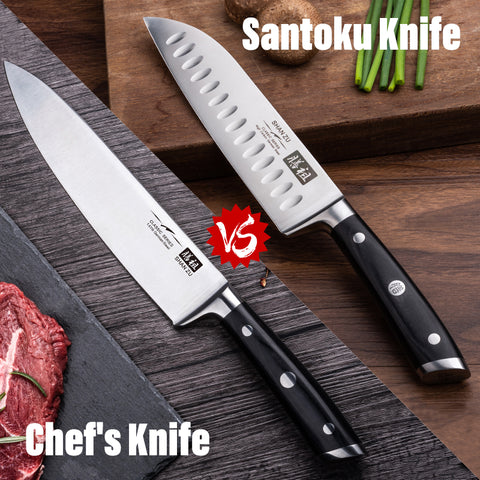
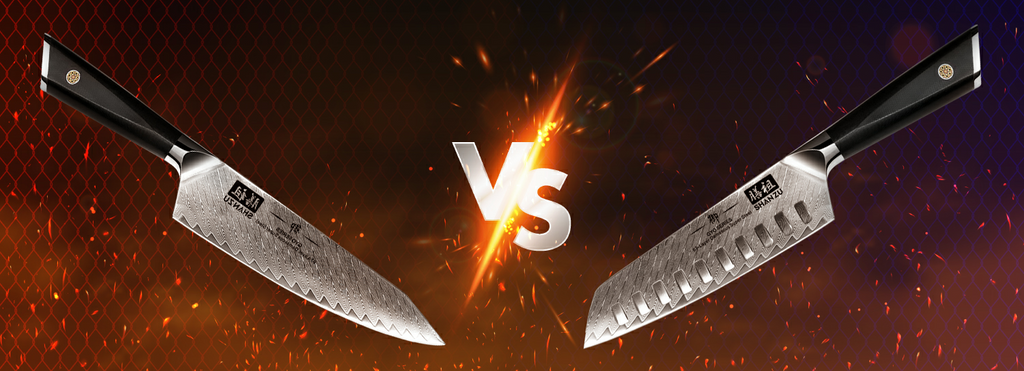
In the culinary world, there are two types of chef’s knives that serve as multipurpose kitchen tools: the classic Western-style chef’s knife and the Japanese-style Santoku knife.
Both are designed as kitchen essentials—the go-to knives for many professional chefs, home cooks, and food lovers. They are versatile enough to handle a range of tasks in both professional and home kitchens. Both Santoku knives and chef’s knives are multipurpose, wide-bladed cutting tools used for slicing, dicing, and chopping, and can often be seen side by side on the cutting board.
Both blades can be made from a variety of materials, such as ceramic or metal, with a thin, sharp edge maintained at an acute angle to slice through various ingredients. Although most home and professional cooks prefer steel kitchen knives for their durability, resilience, and performance, handle materials range from hard plastic to wood to stainless steel. Some knives have a bolster to protect your fingers while chopping and slicing, while others have ergonomic handles for a more comfortable grip.
2. Differences Between a Chef’s Knife and a Santoku Knife
As the most popular versatile kitchen knives, both chef’s knives and Santoku knives can be used for a range of meal-preparation tasks, fulfill your daily kitchen needs, and give you a joyful experience when cutting, slicing, mincing, and chopping.
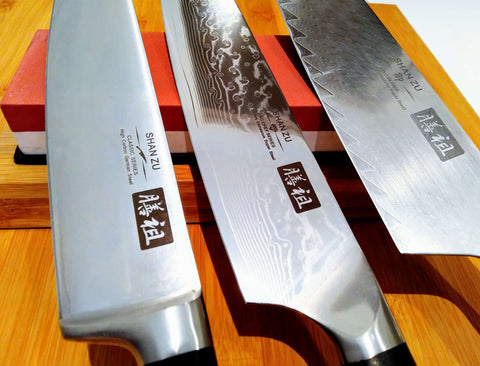
However, not all multipurpose knives are the same. Some differ greatly in how they perform these tasks, as well as in their construction and origins. A Santoku knife differs from a chef’s knife in its material, shape, weight, size, and heritage.
Because of differences in design, the way each knife contacts the cutting board requires different skills and cutting techniques, allowing you to make the most of each knife’s features.
Blade materials
The steel in a typical chef’s knife blade contains less carbon than that in a Santoku blade, resulting in lower hardness but also lower brittleness. In the world of steel, hardness and toughness are inversely proportional. A hard blade, such as a Santoku knife, is more brittle and chips more easily. A tough blade, such as a chef’s knife, is more resilient but cannot achieve the same level of sharpness.
As a result, a sturdy chef’s knife is easier to maintain and sharpen. A Santoku knife retains its sharp edge longer, making it ideal for cutting and chopping, but it cannot withstand forceful cuts against hard objects. It also requires more care to prevent rust, so you should try to keep it dry after each wash.
Blade edge and weight
A Santoku knife, which originated in Japan, is a relatively lightweight, thick-bladed, all-purpose kitchen knife. Unlike the longer, pointed blade of a chef’s knife, a Santoku knife has a straight edge and a rounded tip. So instead of the rocking motion you may use to cut with a chef’s knife, cooks use more of an up-and-down chopping motion with a Santoku knife.
The blade and edge of a Santoku knife are also thinner than those of a chef’s knife. Santoku knives are often made from thinner forged steel, which makes the edge harder and allows the knives to retain their sharpness longer. However, Santoku knife blades can be more difficult to sharpen. The sharp edge of a Santoku knife makes it better suited to detailed work. While a Santoku knife is the preferred choice for precise cuts and detailed work in the kitchen, a chef’s knife is a more versatile, all-purpose option.
Blade length
Although they may look quite similar, chef’s knives generally tend to be longer. Usually, a Western chef’s knife is between 8 and 12 inches long, while most Santoku knives are shorter, at around 5 to 8 inches.
Bevel
Most chef’s knives have a double bevel, with a 15° to 20° angle on both sides of the blade. Most Santoku knives, however, have a single bevel, although double-beveled Santoku knives are also available. A single bevel means that only one side of the blade is sharpened at an angle of 10° to 15°. As a result, it has a sharper edge than a chef’s knife.
Handle bolster
When it comes to handle design, the difference between a Santoku knife and a chef’s knife is the bolster. A Western-style chef’s knife has a bolster, which provides better control of the knife. Traditionally, Santoku knives connect directly to the handle without a bolster.
To better understand chef’s knives and Santoku knives, let’s look at the features and uses of each type. Then we’ll have a better understanding of the differences and similarities between these two types of knives.
3. What Is a Chef’s Knife?
-
Main Features of a Chef’s Knife
Chef’s knives are seen as universal kitchen tools used for a range of different tasks. Often referred to as the most important tool in the kitchen, the Western-style chef’s knife has many uses in the kitchen.
It’s important to know that there are some subtle differences between French-style and German-style chef’s knives. French knives tend to have a flatter shape at the heel of the blade that gradually reaches toward the point, whereas German-style knives have a more curved blade.
- Origin: Germany and France.
- Composition: Can be made of a number of materials, including carbon steel and ceramic, but stainless steel is the most common.
- Steel Hardness: Softer
- Blade Shape: The blade is broad, curving upward to form a tip.
- Blade Length: Varies in size from 8” to 12”.
- Handle Bolster: Usually features a bolster.
- Edge: Usually only double bevel.
- Weight: Moderate to hold.
- Angle: With a 15 to 20° angle on both sides of the blade.
- Grantons: Uncommon
- Cutting techniques: Rocking motion
- Best tool to sharpen a chef’s knife: Honing steel
4. What Is a Santoku Knife?
-
Main Features of a Santoku Knife
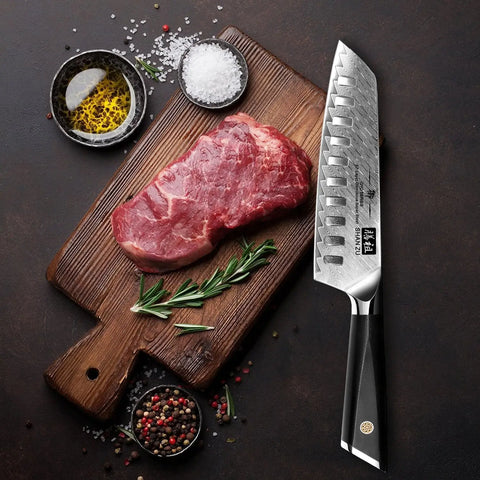
Santoku knives, or, to give them their full name, Santoku bōchō knives—which translates as “three uses”—are ideal for mincing, dicing, and slicing.
Some chefs say these three features refer to using three different parts of the blade, which means using the main cutting edge for slicing, the heel for intense chopping, and the tip for detailed work. Others say it simply refers to cutting meat, vegetables, and fish. Whichever interpretation you prefer, the Santoku knife’s many uses make it a kitchen essential.
Like other Japanese knives, Santoku knives are thin, hard, and quite sharp. Some Santoku knives feature an asymmetric grind, meaning they can only be used in either the right or left hand.
Usually, there are some grantons along the length of the blade. These are said to reduce friction and help vegetables not stick to the knife during slicing and dicing.
- Origin: Japan.
- Composition: Can be made of other materials, like ceramic or carbon steel. But usually made of stainless steel.
- Steel Hardness: Harder
- Blade Shape: Thinner blade, which allows for more refined slicing.
- Blade Length: Varies in size from 5” to 7.9”.
- Handle Bolster: Does not usually feature a bolster.
- Edge: Can be single bevel or double bevel.
- Weight: Lighter to hold.
- Angle: with an angle of 10 to 15°
- Grantons: Common. Santoku knives often have a “Granton” edge — those are the dimples on the sides of the blade that keep things from sticking to the knife.
- Cutting techniques: Up-and-down chopping motion
- Best tool for sharpening a single-bevel Santoku: Whetstone
5. How They Serve Your Cutting Needs
A chef’s knife is a highly versatile, all-purpose knife for almost every kitchen cutting task. It can separate a whole roasted chicken into its main pieces, then divide those pieces with precision cuts using its pointed tip.What is a chef’s knife best used for?
- Complex or versatile cutting
- Cutting and slicing; the tip is well suited to separating chicken parts
- Slicing cheese
- Slicing, chopping, or dicing fruits, vegetables, meats, and nuts
For detailed work and precision slicing and cutting, a Santoku knife is the preferred choice. Just make sure to avoid hard objects. Due to its high brittleness, the blade does not hold up well against hard surfaces.
What is a Santoku best used for?
- Cutting meat
- Slicing cheese
- Slicing, chopping, mincing, or dicing vegetables, fruits, and nuts
- Mincing meat or herbs
- Cutting fine slices, particularly useful for vegetables and seafood
6. Best Chef’s Knives and Santoku Knives to Buy
Best Chef’s Knives to Buy
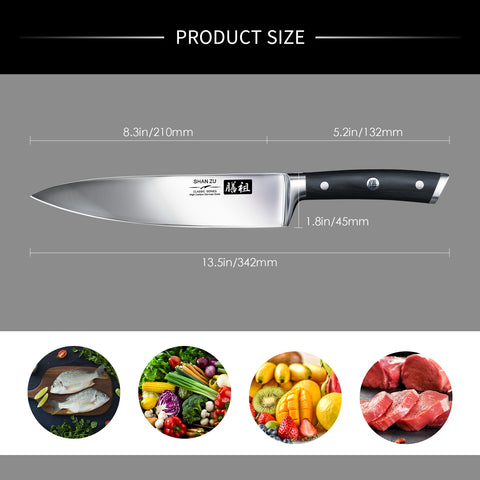
(1)Classic Series Chef’s Knife
Description
Every Classic Series knife has an engraved 膳 on the handle, a word associated with a healthy diet. This versatile Damascus knife is ideal for trimming, slicing, and peeling small produce, making it a true necessity in every kitchen.
Specs
Steel: German 1.4116 stainless steel at 55–57 HRC
Edge: 15 degrees per side using the traditional 3-step Honbazuke method
Handle: Ergonomic pakkawood
Bolster: Full bolster
Blade Length: 8.3 in. /210mm
Total Length: 13.5 in. / 342 mm
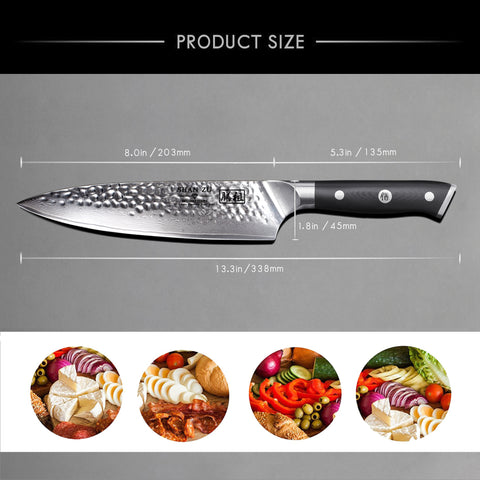
(2)Pro Series Damascus Chef’s Knife
Description
Every Pro Series knife has an engraved 膳 on the handle, a word associated with a healthy diet. This versatile Damascus knife is ideal for trimming, slicing, and peeling small produce, making it a true necessity in every kitchen.
Specs
Steel: Ultra-premium Japanese AUS-10V steel core with 33 outer layers of stainless steel on each side
Edge: 15 degrees per side using the traditional 3-step Honbazuke method
Handle: G10 material
Bolster: Full bolster
Pattern: Breathtaking Damascus Raindrop Pattern
Blade Length: 8 in. / 203mm
Total Length: 13.3 in. / 338 mm
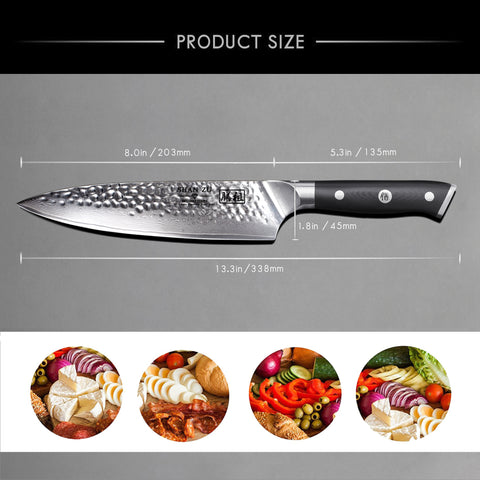
(3)GYO Series Damascus Chef’s Knife
Description
GYO Series features a strikingly geometric design. It has a stylish and unique appearance. An engraved 御 appears on the end cap of the GYO Series, meaning "honor" in Japanese. This versatile Damascus knife is ideal for trimming, slicing, and peeling small produce, making it a true necessity in every kitchen.
Specs
Steel: Ultra-premium Japanese AUS-10V steel core with 33 outer layers of stainless steel on each side
Edge: 15 degrees per side using the traditional 3-step Honbazuke method
Handle: G10 material
Bolster: Full bolster
Pattern: Breathtaking Damascus Rolling Wave Pattern
Blade Length: 8.3 in. / 212mm
Total Length: 14.2 in. / 360 mm
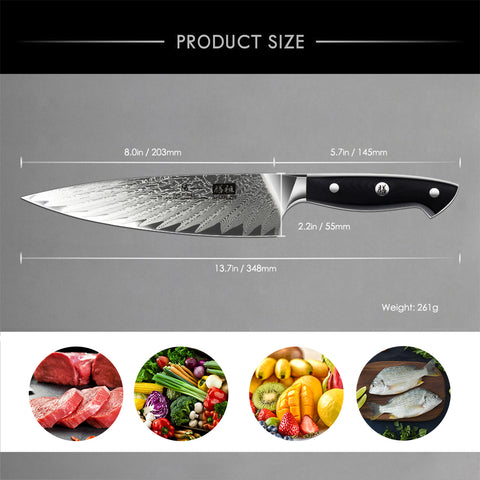
(4)SUN Series Damascus Chef’s Knife
Description
The pattern on the blade resembles the sun's rays, which is why we call it the "陽"—SUN SERIES. The most important tool in your kitchen. This versatile knife excels at any cutting task or technique.
Specs
Steel: Ultra-premium Japanese AUS-10V steel core with 33 outer layers of stainless steel on each side
Edge: 15 degrees per side using the traditional 3-step Honbazuke method
Handle: G10 material
Bolster: Full bolster
Pattern: Breathtaking Damascus SUN Pattern
Blade Length: 8 in. / 203mm
Total Length: 13.7 in. / 348 mm
Best Santoku Knives to Buy
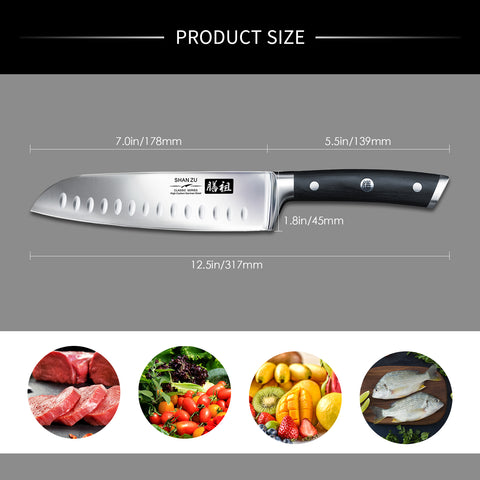
(1)Classic Series Santoku
Description
Every Classic Series handle is engraved with 膳, a character associated with a healthy diet. A Santoku knife is a versatile all-purpose knife that can chop, slice, and dice vegetables, meat, and fish with ease.
Specs
Steel: German 1.4116 stainless steel at 55–57 HRC
Edge: 15 degrees per side using the traditional 3-step Honbazuke method
Handle: Ergonomic pakkawood
Bolster: Full bolster
Blade Length: 7 in. / 178 mm
Total Length: 12.5 in. / 317 mm
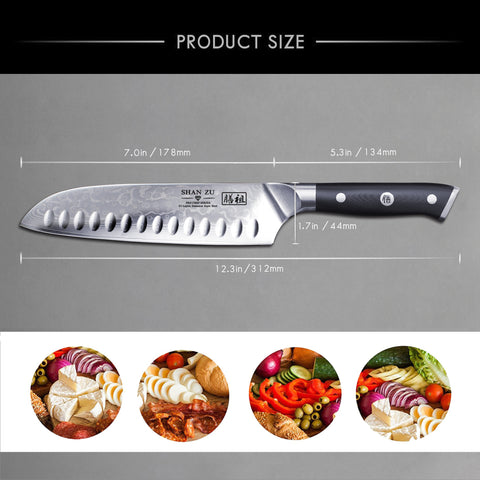
(2)Pro Series Damascus Santoku
Description
Every Pro Series handle is engraved with 膳, a character associated with a healthy diet. Damascus Santoku knives are becoming more common in Western kitchens. They have a wide variety of uses: meats, fish, and vegetables.
Specs
Steel: Ultra-premium Japanese AUS-10V steel core with 33 outer layers of stainless steel on each side
Edge: 15 degrees per side using the traditional 3-step Honbazuke method
Handle: G10 material
Bolster: Full bolster
Pattern: Breathtaking Damascus Raindrop Pattern
Blade Length: 7 in. / 178 mm
Total Length: 12.3 in. / 312 mm
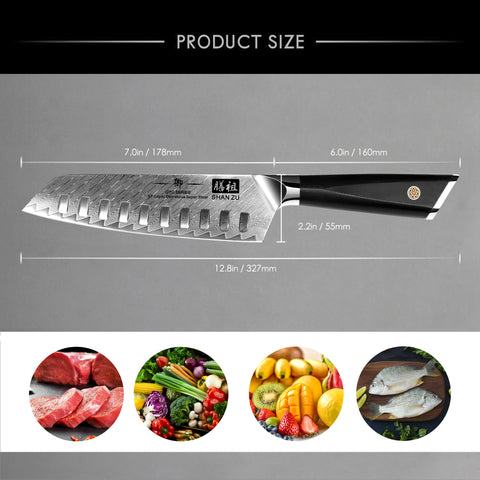
(3)GYO Series Damascus Santoku
Description
The GYO Series features a strikingly geometric design. It has a stylish and unique appearance. The end cap of the GYO Series is engraved with 御, which means “honor” in Japanese. Damascus Santoku knives are becoming more common in Western kitchens. They have a wide variety of uses: meats, fish, and vegetables.
Specs
Steel: Ultra-premium Japanese AUS-10V steel core with 33 outer layers of stainless steel on each side
Edge: 15 degrees per side using the traditional 3-step Honbazuke method
Handle: G10 material
Bolster: Full bolster
Pattern: Breathtaking Damascus Rolling Wave Pattern
Blade Length: 7 in. / 178 mm
Total Length: 12.8 in. / 327 mm
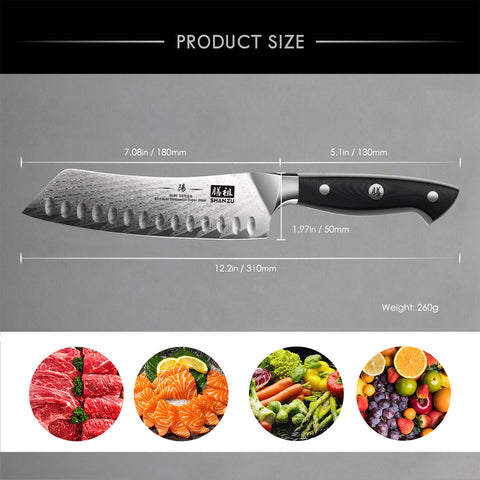
(4)SUN Series Damascus Santoku
Description
The pattern on the blade resembles the sun's rays, which is why we call it "陽"—the SUN SERIES. Damascus Santoku knives are becoming more common in Western kitchens. They have a wide variety of uses: meats, fish, and vegetables.
Specs
Steel: Ultra-premium Japanese AUS-10V steel core with 33 outer layers of stainless steel on each side
Edge: 15 degrees per side using the traditional 3-step Honbazuke method
Handle: G10 material
Bolster: Full bolster
Pattern: Breathtaking Damascus SUN Pattern
Blade Length: 7.08 in. / 180 mm
Total Length: 12.2 in. / 310 mm
7. Frequently Asked Questions About Chef’s Knives and Santoku Knives
(1) Chef’s Knives and Santoku Knives: Which Should I Choose?
Santoku knives and chef’s knives are two of the most popular and versatile knives in today’s kitchen. It’s a very common question: what are the differences, and which is better—Santoku or chef’s knife?
Basically, the knife you choose will depend on your cooking preferences and which knife best suits your grip. The choice comes down to personal preference and your habits with each knife. If you cook a specific type of food—for example, chicken or meat dishes that involve cutting small bones as well as fruits and vegetables—a chef’s knife would be the better choice. If you are planning a menu with plenty of fish, fruits, and vegetables but less meat with bones, then a Santoku knife would be the wiser choice. And if you spend a lot of time enjoying cooking in the kitchen and making a variety of dishes, it is worth having both knives.
Normally, chef’s knives tend to be longer overall. People with larger hands may prefer a chef’s knife because of its bigger size. At the same time, people with smaller hands may prefer a Santoku knife for the same reason. You may also find comfort in what you are used to. However, we encourage everyone to try new things. If you’ve used a chef’s knife for years, give the Santoku a try!
(2) What are the differences in maintaining and sharpening a chef’s knife and a Santoku knife?
Knives should serve you for a very long time, provided you give them the right care, including proper cleaning, sharpening, and storage.
We highly recommend hand-washing and drying both knives with a soft, clean towel. Avoid using dishwashers, and store the knives in a wooden box or block.
The difference between these two knives lies in the sharpening methods used.
For sharpening chef’s knives:
As mentioned, when you need to create a well-defined, highly sharpened edge, you usually use a whetstone to sharpen a knife. It is a superior method. Normally, sharpen a chef’s knife to 15–20 degrees on both sides.
You may also choose to use a honing steel to hone a chef’s knife.
For sharpening Santoku knives:
Because Santoku knives normally have a single bevel and are made from harder steel, it is easier to create a sharp edge. Generally, Santoku knives can be sharpened to an angle of approximately 10–15 degrees.
Because Santoku knives generally do not have a bolster, they are easier to sharpen. Single-bevel Santoku knives also require less sharpening than double-bevel knives.
The most effective way to sharpen a Santoku is to use a whetstone. Whetstone sharpening produces a finer, sharper edge than other methods.


Comments (0)
There are no comments for this article. Be the first to leave a comment!