

- What Is a Deba?
- The Deba Profile
- Deba History
- A Deba in Detail
- The Shape
- The Center of Gravity
- Sharpness
- The Handle
- The Deba at Work - How to Use It
- The Deba Blade: Material and Structure
- Carbon Steel
- Stainless Steel
- Damascus Steel
- Deba Care, Storage, and Sharpening
- Summary of Deba Buying Criteria
What Is a Deba?
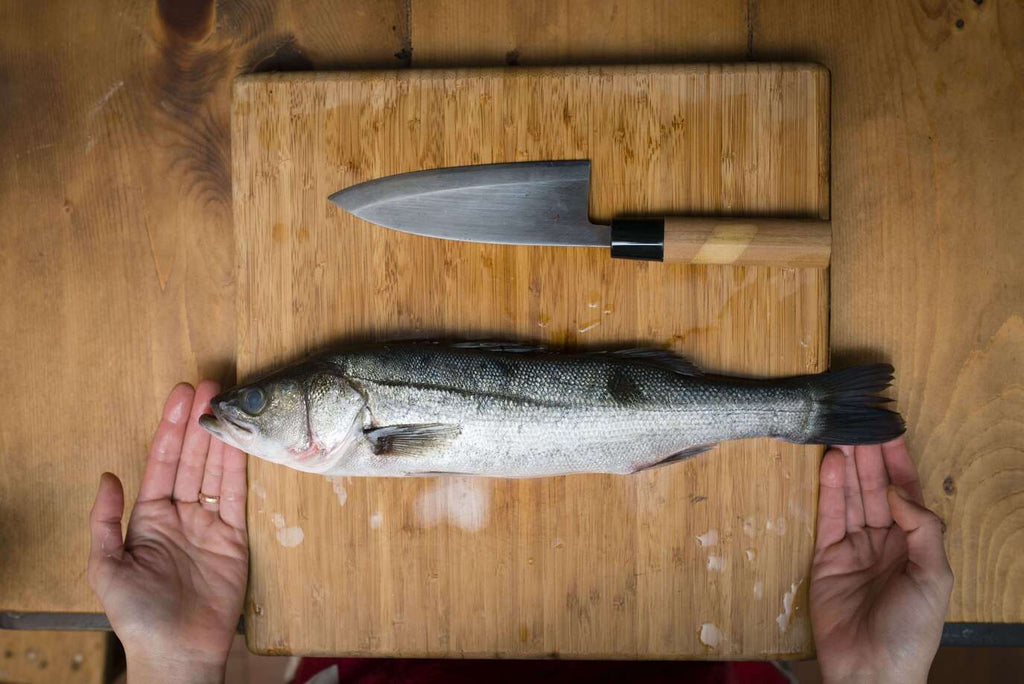
The Deba knife is a traditional Japanese kitchen knife with a unique design and purpose. It is a single-beveled knife with a thick, heavy blade used to slice and fillet fish. Unlike other kitchen knives, the Deba is specifically designed to cut through fish heads and bones, making it an essential tool for Japanese chefs who specialize in preparing seafood dishes. This powerful specialist knife for cutting fish and meat is often found in Japan's traditional kitchens and fish and meat markets. In Europe, knives resembling a Santoku or short Gyuto are relatively unknown. The Deba's thick blade is also suitable for cutting meat, poultry, and soft vegetables such as tomatoes and cucumbers. However, for those who have already learned to appreciate the legendary knife steels of Japan and exten
The Deba Profile
- Primarily used for cutting fish and meat
- Blade shape similar to that of a Santoku
- Blade length between 12 and 30 centimeters, typically 15 to 18 centimeters
- Blade thickness of up to 6 millimeters, making it relatively heavy
- Single-sided bevel, for right- or left-handed use
- Classic buffalo-horn ferrule to hold the blade in place
- Usually fitted with a magnolia-wood handle with an oval or chestnut-shaped cross-section
Deba History

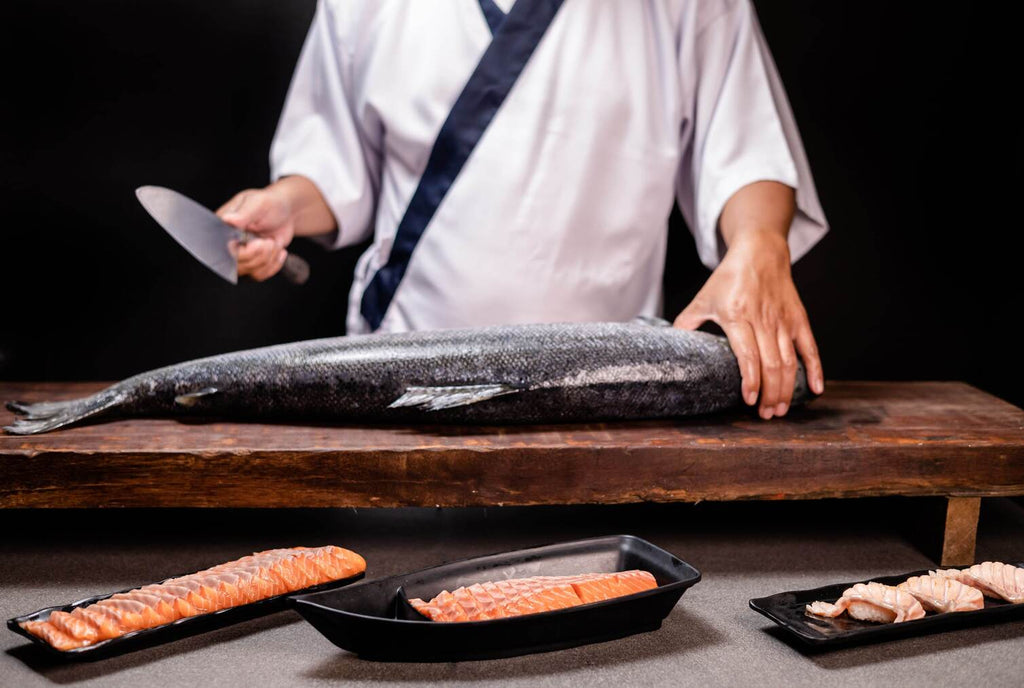
The Deba (Japanese for "pointed carving knife") is one of Japan's oldest kitchen knives. It originated around 1700 in Sakai, the great trading and port city of Osaka and a center of samurai swordsmithing, which gradually shifted toward civilian production. The Deba's design is the result of centuries of refinement by Japanese chefs and blacksmiths, and its shape and structure have remained largely unchanged. Even then, Sakai held a monopoly through regional trademark rights for knife making, and its Deba was regarded in the blacksmithing metropolis as a teaching piece for young blacksmiths. Even today, each of Sakai's remaining factories maintains its own style and method of producing exquisite Deba knives. Traditional rituals, procedures, and recipes remain fixed, and the finest specimens are signed by hand, as swords once were. Their extraordinary, mostly multi-layered steels and unusual sharpness are legendary even in Japan, making connoisseurs' hearts leap with joy despite four-digit euro prices.
A Deba in Detail
The Shape
The Deba knife could be considered a cross between a cleaver and a Santoku knife. In side profile, the blade is very tall and the cutting edge slightly curved, while the strong spine tapers only toward a blunt-angled tip at the end of the bevel. Deba lengths vary somewhat to accommodate different-sized ingredients. Japanese cuisine uses many different types and sizes of seafood, so Deba knives are available in numerous sizes and styles. The strength of the rear section of the blade is comparable to that of a European cleaver.
The Center of Gravity
The Deba's greater weight makes it clear that Japanese knives have their center of gravity in the rear third of the blade, rather than between the blade and handle as with European knives. This weight distribution helps the Deba cut through large ingredients, but it also creates a risk that the knife may slip from your hand and land tip-first.
Sharpness
The secret of the Deba's extreme sharpness despite its robust blade lies not only in the material but also in the grinding. Deba knives are sharpened very steeply and extensively on one side only. This makes them ideal for the most precise, straight, and thin cuts, while the opposite side of the blade always has a slight hollow grind. In this way, the forger reduces sticking to the ingredient being cut, friction during cutting, and the amount of force required. However, using it may feel unfamiliar at first.
The Handle
Traditional Japanese cleavers secure the solid blade to a wooden Wa handle with a seamless buffalo-horn ferrule. High-quality resin or specialty plastics can serve as viable buffalo-horn substitutes, but cheap plastic cannot. Debas with classic European handles in ergonomic shapes are also available. With straight Japanese handles, an oval cross-section is standard. Longitudinal ridges often improve vertical grip: the chestnut shape has one, while hexagonal or octagonal handles have several.
The Deba at Work - How to Use It
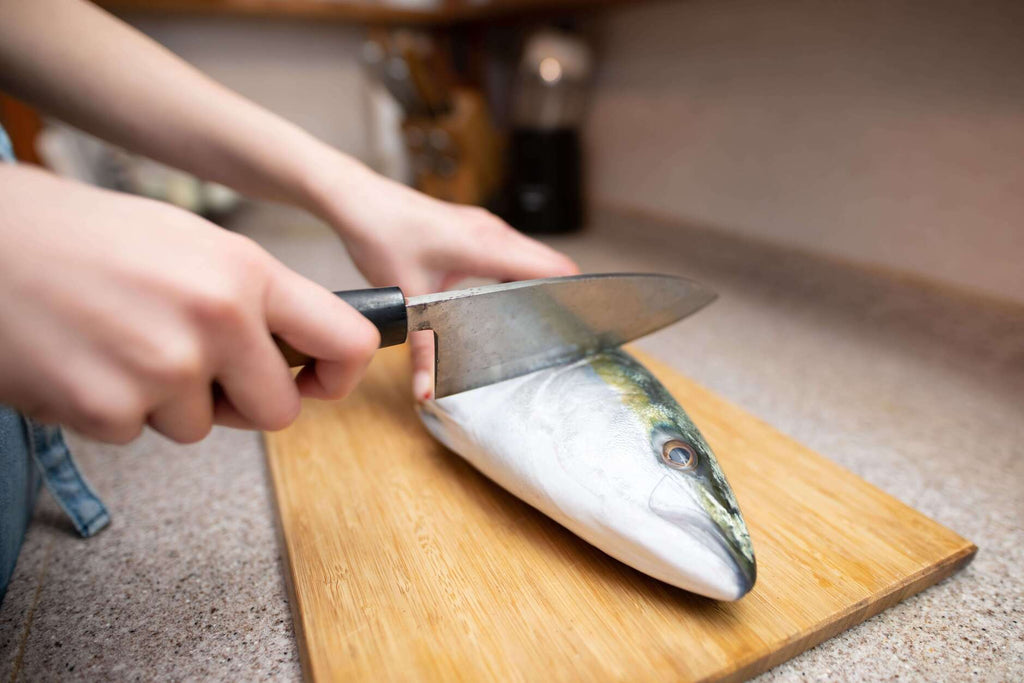
The most important thing for Europeans using a Deba is to understand that this Japanese cleaver is not designed for chopping in the way we may be accustomed to. Neither the handle construction nor the thinly ground edge can withstand the force of an axe blow. When dealing with backbones or bones, use the back of the knife as a breaking tool. The tip is ideal for scaling, skinning, and carving delicate fillets. The single-sided grind produces exceptionally smooth surfaces but requires some practice at first. At Japanese fish markets, the Deba is the most widely used tool, and skilled fishmongers use it to prepare whole fish into bite-sized pieces in no time. Of course, the Deba is an essential tool for any chef who specializes in preparing seafood dishes. Its thick, heavy blade is designed to slice through fish quickly and easily, as well as to fillet them precisely. The Deba is also versatile enough to cut meat, poultry, and soft vegetables. Its unique design makes it an excellent tool for preparing sushi, as its thick blade can slice through ingredients without crushing them. A great Deba can do much more: cut large pumpkins, bone and portion tender beef and poultry, chop delicate radish leaves, and mince herbs. Nevertheless, it is not a universal knife because of its weight and single-sided bevel.
The Deba Blade: Material and Structure
The solid blade of a Japanese cleaver is where the properties of the steel, forging and hardening skills, and sharpening all come together. Maximum sharpness must be combined with robustness and durability. Authentic Debas either have a core of high-quality carbon steel, ranging from Shirogami to Aogami, or are forged from two to many layers of carbon steel combined with softer iron or alloy steel. More modern models offer good alternatives in stainless mono-steel.
Carbon Steel
Advantages: It achieves the highest hardness (HRC 63 to 66), providing maximum sharpness and edge retention at reasonable prices. Disadvantages: It is susceptible to corrosion and breakage and therefore requires significant care and maintenance, including oiling. Impacts, lateral stress, and excessive hardness can inevitably cause damage, potentially ruining the beautiful knife. Suitable for you if you are looking for an authentic Japanese Deba with a patina and a long-lasting, razor-sharp edge, and are willing to invest some effort in its care. "A good choice for professional chefs and enthusiastic home cooks."
Stainless Steel
Advantages: This softer material is rust-resistant, flexible, and resilient. Some models may even be dishwasher-safe, and they are otherwise easy to maintain at a reasonable price. Disadvantages: It provides good, but not exceptionally sharp, performance and requires more frequent sharpening. Suitable for you if the Deba is new to you, you use it only occasionally, or you value toughness more than the last degree of sharpness. "Suitable for everyone from recreational cooks to professional chefs."
Damascus Steel
Advantages: In the best sense of the word, diverse alternating layers of hard and soft steels distribute their best properties throughout the blade. For many people, striking Damascus is not only functional but also the aesthetic crowning achievement of Japanese knife making. Disadvantages: Knives designed to last a lifetime come at a price that not everyone considers justified by the improvement in cutting performance. Beware: not everything labeled Damascus is actually hand-forged. Suitable for you if you are prepared to pay more for the highest quality among Debas and find nothing more beautiful than a shimmering Damascus knife. "The dream of every knife enthusiast's collection in professional and home kitchens."
Deba Care, Storage, and Sharpening
Always cut on a wooden or plastic board, never on a hard surface, and above all, avoid chopping motions. Do not put non-stainless steels through the harsh dishwasher; wash them by hand immediately after use if you want them to last. Then dry the knife and apply a light coat of oil; camellia oil is traditionally recommended. Some stainless steels may safely be washed in the dishwasher. Also remember to oil wooden handles from time to time. For sharpening at home, you will definitely need a whetstone because the Deba is honed on its beveled side. The opposite side only needs light deburring. Store the Deba in a drawer only if it is protected from impact, for example in its original box. Alternatively, use a properly sized knife block or magnetic strip.
Summary of Deba Buying Criteria
In conclusion, the Deba is an essential tool for any Japanese chef who specializes in preparing seafood dishes. Its unique design and construction make it highly versatile, as it can be used to cut fish, meat, poultry, and soft vegetables. Its thick, heavy blade is designed to slice through fish quickly and easily while also allowing precise filleting, so you may not need another knife. This powerful Japanese cleaver should fit your hand perfectly in terms of length, weight, material, and handle shape, so test how comfortable and manageable it feels. Think carefully about which material best suits your applications, requirements, and budget: extremely sharp but sensitive carbon steel, practical stainless steel, exquisitely layered steel, or premium Damascus steel. Attractive looks alone are of little use in the kitchen. High-quality materials are important, but they do not by themselves make a durable, high-quality knife. Therefore, examine the knife closely and look for proper workmanship. Read genuine reviews, verify the information, or trust reputable manufacturers with a strong track record so you can make the right investment.


