


SHAN ZU | 2-in-1 #1000/#6000 Grit Whetstone

SHIPPING POLICY
Delivery to Austria, Germany, Italy, France, Sweden, the United Kingdom, the Netherlands, Spain, Belgium, Cyprus, Denmark, Finland, Greece, Hungary, Iceland, Ireland, Liechtenstein, Lithuania, Norway, Poland, Portugal, Romania, Switzerland, and the United States.
For the best experience, please use the SHAN ZU website corresponding to your geographic location:
- Europe: www.shanzuchef.com (prices in euros)
- United States: www.us.shanzuchef.com (prices in dollars)
This ensures the correct warehouse, faster shipping, and avoids customs fees.
- We can deliver orders to customers in the countries listed above.
- Delivery time: 5–7 business days.
- Please note that all packages are shipped by SHAN ZU. There are no additional taxes on our products, which means that you only need to pay the final sale price when you purchase from SHAN ZU.
Learn more about the shipping policy.
RETURN POLICY
After receiving the product, please check “whether the product is defective” and “whether it matches the contents of the order.” If either of the issues mentioned above occurs, please contact us by email: shanzu@shanzuchef.com. We will respond within 48 hours of receiving your return request.
IMPORTANT: For items that arrive damaged or defective, YOU MUST provide photos/videos supporting your claim that the item arrived damaged or is malfunctioning. If a customer refuses to send or does not send photos/videos of an allegedly damaged or malfunctioning item, the return will be treated as “buyer’s remorse,” and the customer will be solely responsible for reshipping the item. The customer will also be subject to a 15% restocking fee and the shipping costs paid by the seller. If a customer claims that an item is defective/damaged, they must provide proof before returning it, without exception. Use the contact form to submit photos/videos for your return request.
SPECIAL FEATURES
A knife-sharpening whetstone is an essential tool in every kitchen.
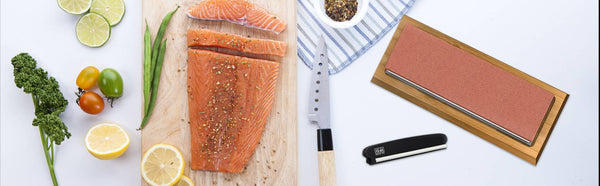
- Knife sharpening master: The SHAN ZU whetstone is designed to make your knives razor-sharp and provide an extra-fine polish for your blades. This allows you to cut, slice, and chop food with ease.
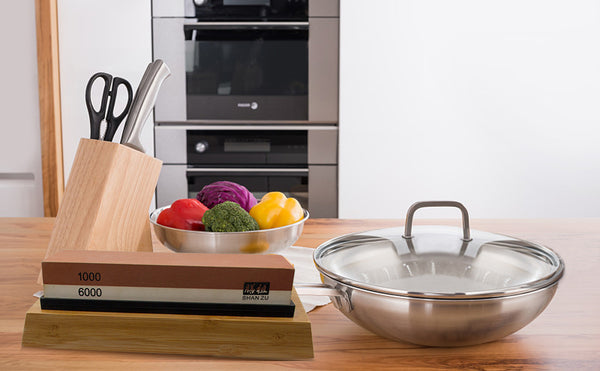
- 2-in-1 design: The white corundum whetstone has 2 different sides—a coarse side (1000 grit) and a finer side (6000 grit). The 1000-grit side can restore even the dullest blade to a straight, sharp edge, while the 6000-grit side sharpens and polishes that edge to achieve astonishing sharpness.
- Non-slip base: The non-slip silicone gel and bamboo base keeps the whetstone firmly in place, ensuring maximum safety during sharpening.
- Angle guide included: For a better sharpening experience, an angle guide is included to maintain the sharpening angle while saving energy.
- Whetstone specifications: The red side has a grit of 1000; the white side has a grit of 6000. The stone's overall size is 180*60*27mm.
HOW TO SHARPEN A KNIFE?
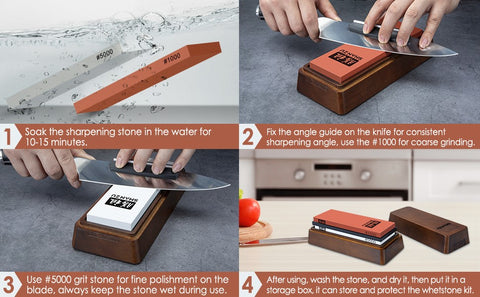
- Soak the whetstone in water for approximately 5 minutes so that it can fully absorb the moisture.
- Choose your sharpening angle according to the type of knife: 17 degrees: Razor, sushi knife, chef's knife, and kitchen knife; 20 degrees: Pocket knife, fruit knife, and boning knife; 25 degrees: Field knife; 30 degrees: Bayonet or field knife; 40 degrees: Survival knife.
- Use the bamboo base to hold the whetstone, attach the knife angle guide, and get ready to sharpen.
- Use the whetstone, sharpening back and forth according to the blade angle. First use the #1000 stone for 10 to 15 minutes for coarse sharpening, then use the #6000 stone for 10 to 15 minutes for fine sharpening.
- After finishing sharpening the knife, wipe it with a damp cloth or rinse it with water, then rinse the whetstone directly with water and leave it in the open air to dry.
- To maintain moisture and prevent the temperature from becoming too high, add water or oil as appropriate during the sharpening process.
Child’s Play to Master
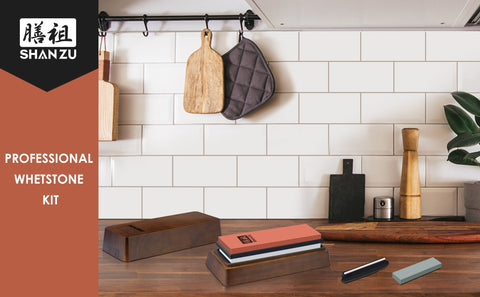
Our sharpening stone kit is extremely beginner-friendly and easy to assemble.
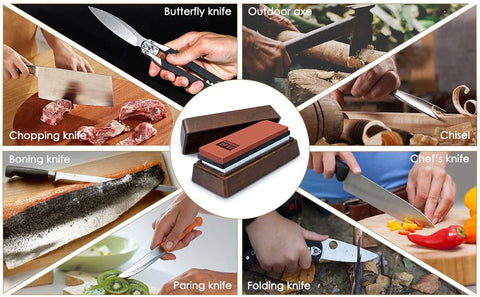
Versatile Use
Sharpens fillet knives, sushi knives, pruning shears, straight razors, scissors, axes, hunting knives, and much more.
L'avis de Nos Chefs Pros
Ne nous croyez pas sur parole, lisez ces témoignages!
Rejoignez le club exclusif SHAN ZU!










What matters most to you
Free standard shipping on all orders. SHAN ZU kitchen knives on sale worldwide.
*The following regions are excluded: remote islands of France and Spain, Switzerland, Australia, Canada, Africa, and the Middle East.
SHAN ZU kitchen knives for sale worldwide.
*The following regions are excluded: United Kingdom, Ireland, Australia, Canada, Africa, Middle East.
Delivery time depends on the destination. Generally, it takes between 3 and 14 days. International shipping is available to most countries. If we cannot deliver to your country, we will contact you. In addition, we will keep you informed about your order by sending you an "order confirmation" and a "shipping notification" after you place your order.
Returns are accepted within 45 days of the delivery date, in accordance with our refund policy. Simply send us an email, and we will tell you what to do next.
Official SHANZU email: shanzu@shanzuchef.com
To clean and maintain your knife, it is best to follow these steps: First, clean the blade with hot water and dish soap. Be sure to rinse and dry the blade thoroughly to prevent it from rusting. Next, use a sharpening steel to sharpen the blade.
Next, use a sharpening steel to sharpen the blade. This will help maintain the edge and ensure that the knife is in good working order.
If the blade is very dirty or food has become stuck to it, you can use a soft-bristled brush to clean it gently. After cleaning and sharpening the blade, apply a thin layer of oil to the blade and handle. After cleaning and sharpening the blade, apply a thin layer of oil to the blade and handle to prevent rust and keep the knife in good condition. Finally, store the knife in a safe, dry place away from heat and moisture. Finally, store the knife in a safe, dry place away from heat and moisture. A knife block or drawer organizer is a good option, as it will protect the blade and prevent accidents.
To sharpen a knife, you will need a SHANZU whetstone or a knife sharpener. To use a whetstone, first soak the stone in water for about 10 minutes. Then place the knife flat on the stone and tilt the blade so that it forms a 10- to 15-degree angle with the stone. Using long, steady strokes, move the blade back and forth across the stone, making sure to maintain the blade’s angle. After a few strokes, move the blade to the other side of the stone and repeat the process. You should sharpen the entire length of the blade, and you may need to repeat the process several times to achieve the desired level of sharpness.
What is Damascus steel?
The origin of the name "Damascus steel" is disputed: two Islamic scholars, Al-Kindi and Al-Biruni (around 800–873 CE), both wrote about swords and sword steels based on their appearance, the geographical location where they were produced or forged, or the name of the smith. Both authors also mention the terms "damscene" or "damascus" when describing swords to some extent.
Based on these references, there are three possible sources for the term "Damascus" in the context of steel:
Al-Kindi refers to swords forged in Damascus, Siberia, as "Damascene," but it is important to note that these swords are not described as having a wavy appearance on the surface of the steel.Al-Biruni refers to a swordsmith called Damasqui who made crucible-steel swords.In Arabic, the word "damas" means "watered," and Damascus blades are often described as having a water-like pattern on their surface.
The most common explanation is that the steel is named after Syria's capital, Damascus, the largest city in the ancient Levant. The most common explanation is that the steel is named after Syria's capital, Damascus, the largest city in the ancient Levant. It may refer to swords made or sold directly in Damascus, or simply to the appearance of the characteristic patterns, by comparison with damask fabrics, which also take their name from Damascus.
What is German steel?
German knives are generally made of stainless steel with a Rockwell rating between 56 and 58. Stainless steel contains chromium. This is what lowers the Rockwell rating. The advantage is that the knife blade resists corrosion and rust.
Cooks generally agree that German-style stainless-steel knife blades are more durable than Japanese-style blades. Cooks generally agree that German-style stainless-steel knife blades are more durable than Japanese-style blades. Their durability allows you to use them for more cutting and chopping tasks.
The softer nature of this steel allows it to retain a sharp edge, but requires more frequent sharpening and honing. Although this softer steel makes the blade easier to sharpen, it also means that German knives lose their edge more quickly than Japanese knives made from high-hardness, high-carbon steel.

