
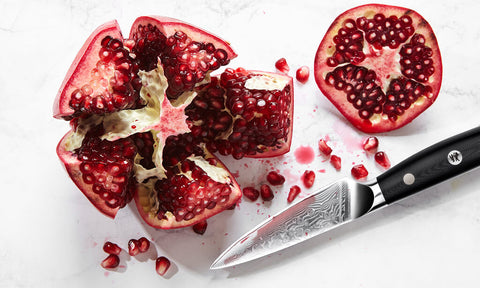
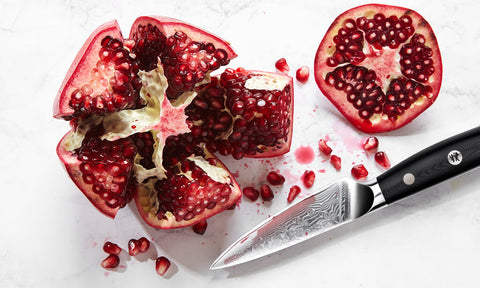
Snowmen aren't the only highlight of winter; pomegranates share the limelight too. Pomegranates are worth the wait because of their beautiful red arils and juicy taste. But if you're not sure how to cut a pomegranate without making a mess, it can be frustrating.
If you're wondering how to cut a pomegranate and enjoy every bit of it, you've come to the right place. Nature safely packs the seeds, which are full of vitamin C, antioxidants, fiber, and other nutrients, inside a thick red shell. Here, you'll learn the correct technique for removing the jewel-like red arils from a pomegranate without making your kitchen look like a murder scene.
What Is a Pomegranate?
Before learning how to cut a pomegranate, let's first understand what it is and what its jewel-like seeds contain.
Pomegranate is a winter fruit available from late October through November. It looks much like a red apple with a flower-shaped stem. It contains small, red, juicy seeds called arils. They have a sweet-tart flavor and a crunchy texture that bursts with juice in your mouth.
The arils rest inside a soft white interior, enclosed by a reddish, hard exterior. A single pomegranate contains hundreds of nutrient-rich seeds that can be used in salads, desserts, or mocktails.
Health Benefits of a Pomegranate
Pomegranates are worth the wait because of their numerous health benefits. Studies have shown that pomegranates are among the healthiest fruits on earth. Learning about their benefits will make you eager to discover how to cut a pomegranate without losing a single seed.
Pomegranates are packed with nutrients important for healthy living. One cup of pomegranate seeds contains 3 grams of protein, 7 grams of fiber, 30% of the daily value of vitamin C, 16% of folate, and 12% of potassium.
The two healthiest substances, punicalagins and punicic acid, are also found in pomegranates. Due to their rich punicalagin content, pomegranates have three times more antioxidants than green tea and red wine.
Regularly eating pomegranates can also help protect you from heart disease and cancer. Researchers have found through some test-tube studies that pomegranates can minimize inflammatory activity in the digestive system and help fight breast, colon, and prostate cancer.
Patients with arthritis and joint pain are also advised to add pomegranate to their routine because pomegranate extract can block enzymes responsible for damaging the joints.
So next time you visit a fruit stall, don't feel skeptical about pomegranate, and give it a shot!
How To Tell If A Pomegranate Is Ripe?
We believe you're convinced to give it a shot and your next thought is to tell if a pomegranate is ripe; we got you covered!
Unfortunately, unlike most fruits, you cannot tell if a pomegranate is ripe or not by looking at its color only. The pomegranate color can vary from pink to dark red, which has nothing to do with the inside. If you're thinking scratches Might help you judge, you're wrong.
According to experts, the correct way to judge if a pomegranate is ripe or not is by holding it. If the pomegranate feels heavy, it means the red jewels inside are ready to be eaten and wise versa. In the case of skin, try to find one with a taut and firm cover.
The best technique to judge if the pomegranate you're purchasing is juicy or not pick up a few so you can compare better. Take all your time to consider the weight because it's better to spend time choosing the right pomegranate than ripping the seeds only to know there's nothing useful and tasteful inside.
How Do You Eat A Pomegranate?
After buying a juicy pomegranate, the next step is to understand how to eat and enjoy it to the fullest. For those who don't know, only the seeds of a pomegranate are edible. The rest is just a safety cover to protect the fruit inside.
The correct way to eat a pomegranate is by ripping the seeds from the white shell inside the thick red covering. You can either add the seeds into your salad directly, add it to your dessert, smoothie, oatmeal, yogurt or make a juice of it to give a sweet-tart flavor to your drinks.
But wait!
In order to eat a pomegranate, you first need to learn how to cut a pomegranate in no time.
How To Cut A Pomegranate: A Step By Step Guide
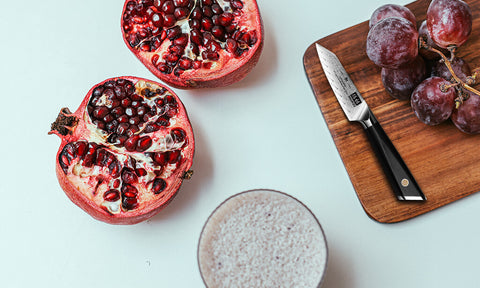
Opening a pomegranate can be messy and time-consuming if you don't have a proper game plan. Here is an effective technique for cutting a pomegranate without making your kitchen look like a crime scene.
Step 1: Cut And Remove The Top
Take a sharp knife and remove the pomegranate top.
Step 2: Make Thin Cuts Along The Ridges
After removing the top, you'll see 5-6 ridges on the surface of the fruit. Because pomegranate is not perfectly round, the number of ridges may vary. Using the same knife, make a partial cut of the fruit along the ridges from top to bottom.
Remember to stay around the red skin and the white part because the aim is to open the pomegranate without cutting the seeds.
Step 3: Pry It Open With Your Hands
Use your hands to open the pomegranate and remove the seeds. To do so, hold the pomegranate in both hands and place both thumbs at its center.
Now gently pull the center apart to separate the fruit sections.
Step 4: Pull Out the Seeds
There are two ways to extract the seeds from a pomegranate.
Most people use a wooden spoon, but you can use other utensils to knock out the pomegranate seeds.
If you're concerned about getting hurt or making a mess in your kitchen and on your counter, this method will work better for you. Remove the seeds by hand, separating them from the white pith with your fingers. To avoid staining your clothes, you can do this step underwater.
Step 5: Separate the White Pith From the Seeds
Fill a large bowl with enough water to properly soak the arils. Wait until the white pith floats to the surface of the water, leaving only the red seeds at the bottom.
Now, strain the seeds.
First, use a filter to remove the white membrane, then strain the seeds.
How To Make Pomegranate Juice From Pomegranate Seeds
If you do not enjoy eating pomegranate because of its seeds, you can switch to pomegranate juice to enjoy its nutritional benefits. Here is a simple technique for making pomegranate juice without any hassle.
Step 1:
Making pomegranate juice is similar to juicing passion fruit. Pour the seeds into a blender and blend only enough to break them up; do not overblend, or the small particles will take too long to separate. Overblending can also affect the pomegranate's original taste. Therefore, blend just enough to extract the juice from the arils.
Step 2:
Now strain the mixture. It might take a few minutes because the thick pulp can block the juice. Use a spoon to gently stir the mixture so the liquid does not remain with the pulp.
Tip: Add a little water while straining to speed up the process.
Step 3:
Add sugar and water, or enjoy it as it is.
Delicious Pomegranate Recipes
Pomegranates are versatile fruits that can be used to prepare a variety of delicious recipes, including desserts, yogurt, mocktails, smoothies, and salads.
§ Mix With Your Salad
In a small skillet, cook some pecans and sugar over medium heat, stirring constantly, until they turn caramel-colored. Transfer the pecans to a bowl to cool, then break them into small pieces. Mix these crunchy pecan pieces with pomegranate seeds, lettuce, red onion, and feta cheese. Drizzle vinegar, olive oil, and lemon juice over the salad, then season with salt and pepper. Enjoy the delicious combination of salty feta cheese and sweet pomegranates.
§ Add It to a Smoothie
Blend some pomegranate seeds in a blender until liquefied. Add some pineapple, banana, Greek yogurt, and maple syrup, then blend again until creamy. Enjoy the refreshing smoothie with some ice.
Best Knives for Cutting a Pomegranate
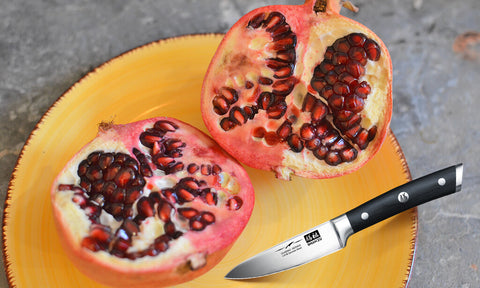
Now that you've learned how to cut a pomegranate, you need a good knife to practice with. Here are some of the best knives you can choose from.
7" Chef's Knife
Features
- Stainless steel
- Medium size
- Light and easy to handle
Pros
- Both right- and left-handed people can use it, thanks to its sleek design
- Comfortable grip
- Sharp enough to cut the fruit conveniently
Cons
- The knife will feel large if you're used to working with small blades
- Not a beginner's knife
8″ Chef's Knife
Features
- Stainless steel
- Non-slip handle
- Optimal weight
Pros
- It can be used for both commercial and residential cutting
- Lightweight construction for easy handling
- Dishwasher-safe
Cons
- The blade might become dull over time
Paring Knife
Features
- Stainless steel
- Lightweight
- Ergonomic polymer handle
Pros
- Perfect for delicate cuts
- The handle is comfortable and non-slip, offering extra safety
- Economical
Cons
- The blade might lose its effectiveness over time.
10″ Chef's Knife
Features
- Includes carbon
- Stainless steel
- Superior resilience
Pros
- Includes a triple-riveted handle that offers safe handling
- Dishwasher-safe, making it easier to maintain
- Sharp enough to cut the fruit conveniently
Cons
- If you're not used to long, sharp knives, you need to be extra careful
- A bit expensive compared with other blades
Frequently Asked Questions About Pomegranates
§ When Are Pomegranates in Season?
Some varieties are available in summer these days, but pomegranates are mid-season fruit. If you want to enjoy a juicy, tasty, and nutritious pomegranate, you can find them only from October to January.
§ How to Choose a Pomegranate?
Pomegranates are not very cheap, so it's wise to be cautious when purchasing one. To find the best pomegranate, full of juice and red seeds, the first thing to check is its weight. It is said that the heavier a pomegranate is, the more juice its seeds contain.
You can also choose a pomegranate by its skin. Look for one with firm skin. However, you should focus more on its weight and consider the skin a secondary feature.
§ Which part of a pomegranate is poisonous?
In general, none of the parts are poisonous unless consumed in large amounts. However, the roots, peels, and stems of pomegranates are inedible and may be unsafe to eat.
§ How do you store pomegranate seeds?
The best thing about pomegranates is that their seeds can be stored. Follow these steps to preserve the red jewels for later.
Take an airtight container or zip-top bag and pour the seeds inside.
Press the sides of the bag to ensure there is no air trapped inside.
Place the bag in the refrigerator. You can store the arils for about 4–5 days using this method.
If you want to keep the seeds for longer:
Line a sheet pan with parchment paper or waxed paper.
Pour the seeds onto it and freeze them.
§ How do you eat a pomegranate?
Only the seeds of a pomegranate are edible. You can either eat the seeds whole or spit them out after sucking out the juice. Use the technique above if you don't know how to cut a pomegranate and remove the seeds.
§ How do you store and freeze pomegranate seeds?
Pomegranate seeds can be preserved for weeks or even months using this method.
Line a sheet pan with parchment paper or waxed paper.
Pour the seeds onto it and freeze them for later use.
§ How do you juice a pomegranate?
Use the following method to make pomegranate juice.
Pour the seeds into a blender and blend until they break apart.
Pour the blended mixture through a strainer to separate the juice from the pulp.
If it takes too long, use a spoon to gently press out the juice.
§ What can you do with pomegranate seeds?
Pomegranate seeds can be used in many recipes. You can add them to fruit salad for a sweet-tart flavor or mix them into yogurt for a different taste. Pomegranate seeds can also be used in desserts, mocktails, smoothies, and other drinks.
§ How do you know which parts of a pomegranate to eat and which to discard?
A pomegranate consists of three main parts:
- Red outer layer
- White inner pith
- Red seeds
Only the red seeds nestled in the white pith contain fiber and nutrients; the rest should be discarded.
It's Pomegranate Time
Pomegranates are healthy and delicious when you know how to cut them properly. This versatile fruit can be used in a variety of recipes to enjoy its unique flavor.
We hope the information above on how to cut a pomegranate, along with the recipes and answers to common questions, will help you buy a pomegranate worth your money.



Comments (0)
There are no comments for this article. Be the first to leave a comment!