
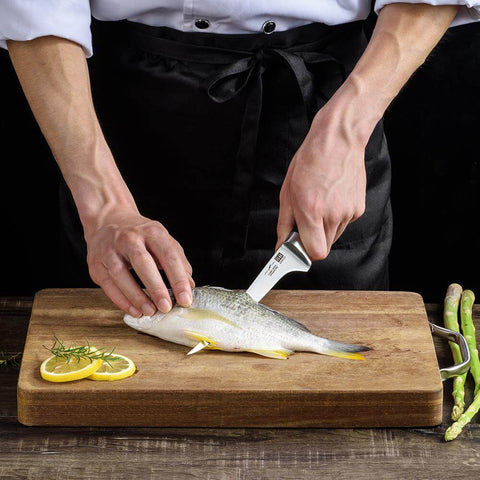
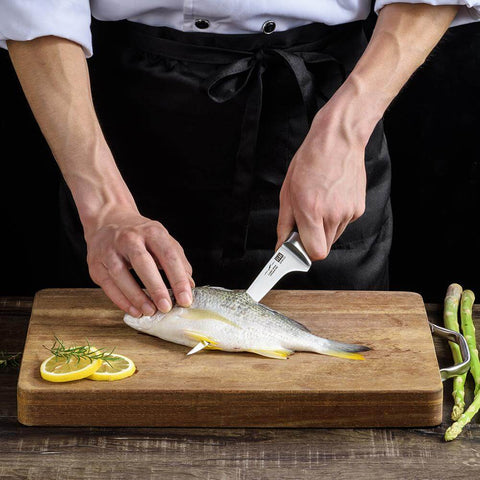
What Is a Filleting Knife?
A filleting knife is used primarily to cut poultry into thin slices. It is specifically used to remove the skin from meat, and since it is used to slice chicken or fish—both quite delicate types of meat—the design of a filleting knife is critical for achieving a clean cut.
Design
Filleting knives are distinctive in their appearance because they are slimmer than the typical knives used for chopping and cutting. The knife's blade is narrow and tapers toward the end, allowing users to cut very thin slices precisely when necessary. Overall, the blade is nearly two-thirds the length of the handle, making the knife easy to hold and enabling accurate cutting.
Features
The most striking feature of any fillet knife is its slim profile and razor-sharp edge. The tip is pointed, making it possible to puncture the meat. It is designed specifically for precision cutting and making delicate cuts without compromising the integrity of the meat. Another special characteristic of a fillet knife is the flexibility of its blade. The knife is used to work with flesh rather than bone, and its flexibility makes it easy to maneuver along the skin, flesh, or cartilage.
Length of the blade
The typical length of a fillet knife is 15 to 28 cm, or 6 to 11 inches. Common blade-length variations for fillet knives range from 4 to 6 inches, 7 to 8 inches, and 9 to 11 inches, with each type suitable for different kinds of fish. Smaller fish, such as trout or mackerel, require a fillet knife with a shorter blade, whereas larger fish, such as tuna, catfish, or halibut, are best handled with long-bladed fillet knives.
What Makes a Good Fish Fillet Knife?
Certain attributes must be carefully considered when determining how good a fillet knife is. Professional knives can be quite expensive, but they are considered a worthwhile investment because of their functionality and durability. A good knife's performance and lifespan depend on the following factors:
Material
The blade material is crucial in determining the lifespan of a filleting knife. A filleting knife blade must be made of high-carbon stainless steel. A high carbon content is important to ensure that the blade is corrosion-resistant, since filleting knives are used primarily on fish and regularly come into contact with seawater. Without a high carbon content, stainless steel filleting knives have a much shorter lifespan.
Thin, Flexible Blades Sharp-Edged Blades
The blade of a filleting knife is also unique in its sharpness and width. The blade is extremely thin. Since it is designed to slice flesh while leaving the bone intact, the thinner blade offers greater control and flexibility, allowing any bones present to be avoided while making cuts. Cutting bones without a proper blade is likely to simply break them and make them even harder to extract.
Another aspect of the blade is its sharpness. Filleting knives are extremely sharp and need to be handled with care. The knife's edge usually has an angle of just 12-17 degrees, demonstrating how acute the razor-sharp edge is.
Blade Length
The blade length for a filleting knife ranges from 6 to 11 inches. As already mentioned, filleting knives come in different blade lengths to match the size of the fish. Shorter blades are great for smaller fish, while longer blades are ideal for cutting and skinning larger fish.
Handle Type
The handle is traditionally made of wood, though knives with high-quality plastic or rubber handles are now common. The shape and material of the handle are more a matter of personal preference than factors affecting how a knife performs. Wooden handles are very sturdy and add weight to the knife, making it easier to handle and use. However, wood can become slippery and difficult to hold when wet, and it is not the easiest material to clean. Plastic and rubber handles offer a much stronger grip and are easy to clean, but they may not be as sturdy as wooden ones. Ergonomically shaped handles also improve grip on the knife while reducing user fatigue.
What Is the Best Knife for Filleting Fish?
A filleting knife is the perfect tool for filleting fish or cutting any kind of fleshy meat that requires precision. The thinness and sharpness of the blade make it ideal for slicing soft, delicate meat and removing the skin from the flesh in a single swipe.
The flexibility of the blade makes it easy to control the knife and avoid any bones that may have been missed during the deboning process. The upward curvature of the blade and the pointed tip are perfect for removing scales, making punctures, or achieving thin slices.
What Is the Difference Between a Fillet Knife and a Boning Knife?
Many people do not consider the different types of knives and just how varied they are in appearance and usage. Trained professionals, however, rely heavily on their tools and know how important it is to use the right type of knife for the right purpose. Two commonly confused types of knives are the boning knife and the fillet knife.
What Is a Boning Knife Used For?
A boning knife is used specifically to separate bones from flesh. The knife is generally flat and has a straight blade with a slight curvature and a sharp tip. The blade is 5 to 7 inches long and sharp enough to cut cleanly through connective tissues and ligaments so that the bones can be removed from the meat cleanly without damaging the meat itself. A boning knife has a denser blade so it can withstand force when cutting near the bone, but it is also flexible enough to provide greater control.
What Is a Fillet Knife Used For?
A filleting knife is used for cutting through flesh and is used once the meat has been deboned. The idea is to make precise cuts of fish or meat. Any bones remaining in the meat are left intact so they do not break and can be removed later with a boning knife if necessary.
Due to their varying purposes, boning and filleting knives are drastically different in appearance and functionality. A filleting knife has a longer blade that is thinner and more flexible. While both are extremely sharp, one is used to separate bones, while the other is used to slice and cut the flesh and remove the skin. Both knives are used to prepare fish for further cooking, but the boning knife is used first to remove the bones, and then the filleting knife is used to cut the flesh.
Fillet vs. Carving Knives
Carving knives are also quite commonly used and may get wrongly labeled as filleting knives. However, there is a difference.
What's the difference?
The key difference between a carving knife and a filleting knife is the blade. While carving knives also have a thin blade, it is much wider than that of a filleting knife.
Examples of a fillet knife
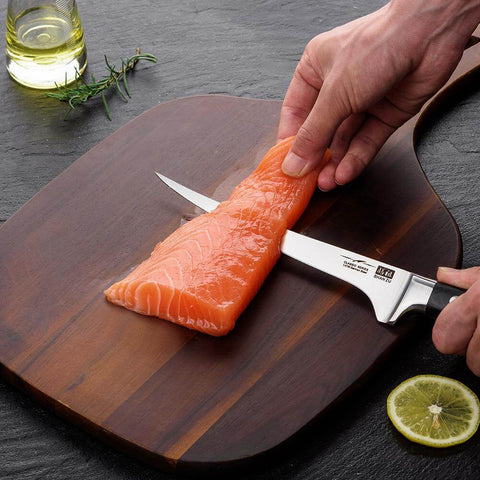
Fillet knives come in many different sizes and types, depending on the material, design, and whether the knife is manual or electric. Some great ones include the Shun Classic flexible filleting knife, which is a high-quality Japanese knife. The Wusthof Classic filleting knife is in a mid-range when it comes to price. A more affordable option also includes the Victorinox Fibrox filleting knife.
What is a carving knife?
A carving knife is designed to cut through meat. It has a long, thin blade, which is wider than the blade of a filleting knife since it is used for meat that is less delicate than the meat a filleting knife is used on. The blade of a carving knife is flexible as well to allow for better control.
Examples of a carving knife
There are many different types of carving knives available on the market, each with a specialized purpose. These include rounded-tip slicers, which do not have a sharp point. Instead, the tip is rounded, and the knife is generally used for slicing delicate cuts of meat, such as ham and even salmon. Since the tip is not sharp, very thin slices are difficult to cut.
Another type of carving knife commonly found is the serrated-edge carving knife. The blade, as the name suggests, is not straight but has tiny teeth. The serrated edge is not good for cutting through meat or fish but is perfect for things such as bread of any kind.
What Kind of Knife Do You Use to Cut Fish?
Examining the different types of knives and their various features, it can be concluded that the filleting knife is the most suitable for cutting fish. The filleting knife is designed specifically to slice through soft flesh and achieve clean cuts. However, preparing fish for cooking or further processing requires the help of other kinds of knives as well. Before the fish is cut, it needs to be deboned, and a boning knife is used for this task. While home chefs and casual cooks may not use specialized knives, in a professional setting where chefs have to prepare large amounts of high-quality cuts of fish and meat, the right kind of knife plays an integral part.
Uses of Filleting Knives You Never Knew
Since a good filleting knife can cost a fortune, some people may be hesitant to purchase one. The amount of fish needed to be prepared for personal use may not justify the high cost of the knife. However, even though it is a specialized knife, it does have multiple uses. The unique and high-quality design makes it suitable for:
Filleting Meat with More Precision
Longer filleting knives are great for achieving thin slices of meat, especially the more delicate cuts like the tenderloin. The knife provides a precise and even cut if you do not have a carving knife to do the same.
Slicing Fruits & Vegetables
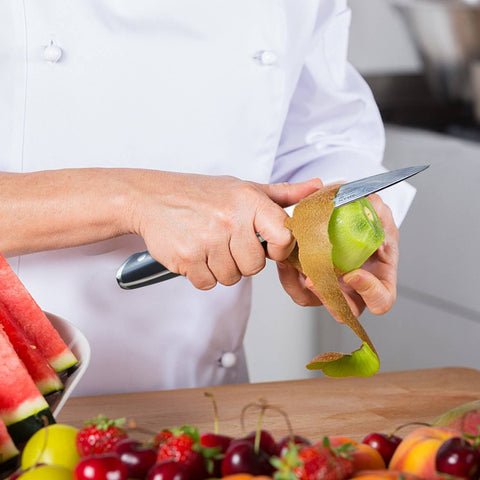
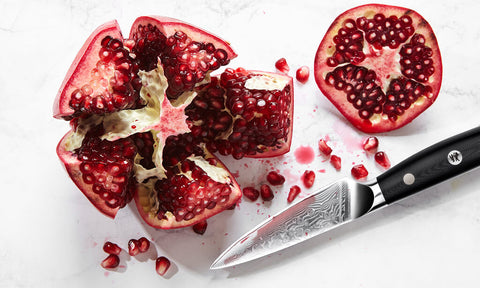
Much like flesh, fruits and vegetables do not have bones and can be cut easily with a fillet knife. In fact, unlike fish, which may need to be held because of its soft texture, many fruits and vegetables are sturdy enough to require very little pressure to keep them in place.
Decorating Your Salads and Vegetables
We already know that a filleting knife can work well for cutting, slicing, and dicing fruits and vegetables. But it is also very useful for cutting fruits and vegetables into intricate shapes for decorative purposes. Carving fruits and vegetables is an art that requires a sharp, precise blade—both characteristics that a filleting knife offers.
Cleaning Fish
The razor-sharp edge and pointed tip of a filleting knife are great for cleaning out fish. Removing a fish's guts, eyes, and gills without damaging the soft flesh is a job that demands a great deal of skill and the right knife. A filleting knife does the job perfectly when wielded by an expert.
Where should you get your fillet knife?
There are plenty of places that sell knives, but getting one for professional use is very different. Professional chefs only buy from well-known knife craftsmen who sell premium knives at a high price. The benefit of paying a high-end price is that these knives are a long-term investment and can perform efficiently for years to come. Chefs rely heavily on their knives, so finding the perfect knife, regardless of the cost, is important to them.
For home use or more casual cooks, there are more affordable options on the market; you can even find some great deals online. The important thing is how you buy the knife you are looking for—that is, checking it for the features you want and need in a good filleting knife.
What do you need to check when getting a fish fillet knife?
To help you get started, here are some features that need to be examined closely before you buy a filleting knife. You must check the knife for:
Handle & Blade Material
The blade needs to be made out of high-carbon stainless steel, especially if you know you will be working regularly with seawater fish. Make sure to ask the right questions; otherwise, you will be left with a knife that will become brittle very quickly. As for the material of the handle, it depends upon personal preference. Some people like the weight and sturdiness of a wooden handle, but sometimes cleaning it can be difficult. Wood also becomes slippery when wet, so going with plastic, rubber, or even a textured steel handle may be better.
Sheath
Having a sheath is always beneficial because the cover protects the blade from damage. When knives are stored with other kitchen tools, their blades may experience wear and tear. A cover can prevent this and help preserve the knife’s integrity for longer.
Electric Fillet Knife
Electric fillet knives are also available, although they can be tricky to use. While they provide speed, this comes at the cost of control. Electric knives can slice through flesh more quickly, but without proper training, it is easy to make mistakes with such a tool.
Length of the blade
The length of the blade depends on your preference. Most people regularly handle small- to medium-sized fish, so a filleting knife with a shorter blade will work just fine. However, if you often cut and clean larger fish, a longer blade is a much better choice.
Flexibility
Blade flexibility is an important feature because it allows the user to avoid bones and make more precise cuts.
Type of fillet knife
Depending on the setting—home or professional kitchen—and the frequency of use, you can decide whether to get a high-end or more affordable fillet knife. Again, this depends on your preference.
Knife origin
Any knife connoisseur knows how important a knife’s origin is. The top places known for making the best knives include Japan and Germany. Japan comes as no surprise, since the country relies heavily on seafood and delicacies such as Kobe beef. Germany, specifically Solingen—also known as “The City of Blades”—is another well-known producer of high-quality kitchen knives.
Ergonomics and safety features
The grip is critical to determining how well a knife performs and how easy it is to maneuver while keeping you safe from cuts. The best way to test this is to hold the knife and see whether its design is ergonomically suited to your hand. How well does the handle fit your hand, and is it comfortable to use even after many hours of cutting, especially when applying pressure? These questions can be answered by taking the knife for a “test drive.”
Price
Filleting knives are available across a wide range of prices. Cheaper models cost between $20 and $30, while more expensive ones can cost as much as $100–$200. How much you are willing to spend depends on your budget and the type of knife you are looking for.
Tips for sharpening your fillet knife
Keeping your knife sharp is essential to getting the most out of your fillet knife. There is a proper way to sharpen the knife so that the blade becomes sharp without being damaged. If you are inexperienced, consider using an electric knife sharpener to avoid injuring yourself. There are two types of electric sharpeners: one removes steel and makes the blade thinner, while the other hones the blade.
Sharpening knives with a stone is best left to those with more experience, but you can follow a few simple tips to get the best results. You will need a bevel angle of 12 to 15 degrees. The usual bevel angle for a kitchen knife is 20 degrees, but it needs to be more acute for a filleting knife. Set the slope at an angle; for 12 degrees, this usually means the height of two quarters stacked together. Once the ideal setup is achieved, move the knife edge away from yourself and then back toward yourself. Continue this motion until you know the blade is sharp. To check whether the blade has been sharpened, test it. Also note that a burr will be visible—a raised edge that forms on the opposite side of the blade. Once the burr is visible, you will know that you have sharpened the fillet knife enough.
Boning Knife vs. Fillet Knife FAQs
1. Who makes the best boning knives?
Some of the best boning knives include the Wüsthof Classic Boning Knife, the Shun Cutlery Classic, and the Mercer Culinary Genesis. For a more professional option, the KYOKU 7-inch Daimyo Series is among the best.
2. Is a fillet knife better than a boning knife?
Neither is necessarily better than the other because they are used for different purposes. A boning knife separates bones from meat, while a filleting knife is used to cut and slice fish and meat. The two can be used together when preparing food.
3. Is a boning knife necessary?
Not really, unless you work in a professional setting and need all the right tools to prepare fish or meat for paying customers. A filleting knife can also be used for deboning when handled correctly.
4. When should you use a fillet knife?
A filleting knife is primarily used for cutting, skinning, and cleaning fish. However, it can also be used instead of a boning or even a carving knife. You can even use it to cut vegetables and fruit; its sharp blade also makes detailed decorative cutting easy.


Comments (0)
There are no comments for this article. Be the first to leave a comment!