
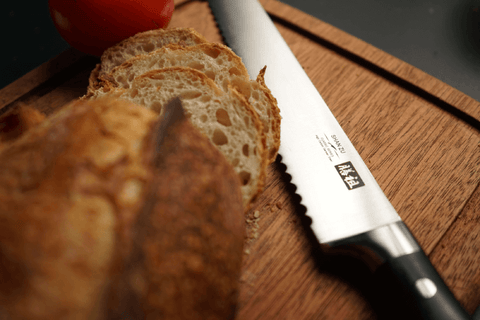
Perhaps you were in the mood to bake today and baked a big loaf of bread. You are proud of yourself for making it this far, and you want to dig right in. But you don’t have a tool to cut the freshly baked loaf into nice, uniform slices. You reach for your straight-bladed knife. However, if anything, the knife made the job harder. This is where a serrated knife comes in.
But the question is, what do you look for when buying a serrated knife? That is what we are here to answer. This guide will help you buy the perfect serrated knife for your kitchen. We will go over what a serrated knife is and how it can improve your kitchen experience. After that, we will detail what you need to look for in your serrated knives. So, stick around until the end.
What Is a Serrated Knife?
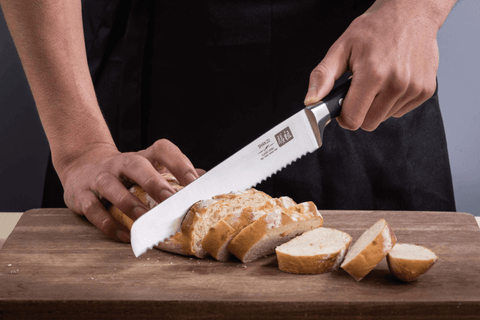
First, what exactly is a serrated knife? A serrated knife is a tool used to cut and slice food that is soft on the inside and hard on the outside.
It can do this due to its toothed edge, which is perfect for handling such food items. As a result, it works similarly to a saw. The blade's teeth sink into the object's surface as it cuts through it.
What Is a Serrated Knife Used For, and Why Do You Need a Serrated Knife?
A serrated knife is ideal for sawing through food. As the name suggests, its primary purpose is to cut bread loaves. Moreover, you can also use it to cut some citrus fruits and slice cake layers without making a mess. If you bake regularly, then this tool is a must-have.
Its teeth can effortlessly grip food without slipping, which also decreases the likelihood of injuries. Hence, this property makes a serrated knife safer than other knives. Moreover, it is easy to use and lasts longer, especially high-quality ones.
What Is a Serrated Knife Called?
Serrated knives are another name for bread knives. They can be easily distinguished from other knives by their toothed edge or saw-like blade. Although some people refer to these knives as bread knives, a serrated knife is far more versatile.
From crusty bread to tender cake layers, you will be able to cut everything using serrated knives.
Is a Serrated Knife Better for Meat?
A serrated knife is relatively standard for chopping up roasts and steaks. It makes the process easy because of its grip. You can effortlessly cut a big steak into bite-size pieces with this knife.
However, some people prefer non-serrated knives, which are slicing knives. These knives make clean cuts and do not tear up the fibers. It makes life easy if you’re a steak lover, so why not try one of our steak knives.
Do Chefs Use Serrated Knives?
Good chefs are picky about the knives they use. Good knives can speed up the food preparation process.
So, chefs carry a knife set wherever they go. Many chefs take at least a set of 3 knives: a paring knife, a serrated knife, and a chef's knife. You too can bring a collection of the three knives as mentioned earlier.
Which Is Better Serrated Or Straight Blade?
Well, it is subjective, and depends entirely on you. As we mentioned before, each knife has its own use. It depends on your kitchen needs. A serrated knife is better than a straight blade for slicing bread loaves and citrus fruits with a hard surface.
A straight blade is better than a serrated knife for peeling and cutting soft fruits and vegetables.
Bread Knife vs. Utility Knife: Which Type Of Serrated Knife Is For You?
A bread knife's most common use is to slice bread. Furthermore, it can also chop or slice tomatoes and even meat. The sole purpose of using a serrated knife is to prepare food and nothing else.
Utility knives on the other hand have a completely different purpose. They are used for, well, utility. Usually you use utility knives for making fine cuts while crafting something. But, you can surely use them as a cooking knife too when proper cooking utensils are not available for you.
But I would argue against using utility knives for cutting bread. Cutting bread requires a jagged edge to ensure you don’t accidentally rip the bread. Also, utility knives are not really long enough to cut your average sized loaf.
Now can you use a utility knife to cut your food? Most definitely. But should you? Well, we’d advise not to. All tools have their own specific uses. Cutting food will be very uncomfortable and not to mention dangerous with utility knives for their small size. And not to mention, switching between crafting and food preparation with the same knife would be quite unhygienic.
What You Should Look For In A Serrated Knife
You should consider a few things before investing in a serrated knife. These range from quality to the care of your knife. Let us look at some things you should look for in your knives.
Quality
The better a serrated knife is, the fewer serrations it has. It is interesting because one naturally thinks more serrations are better. But less is better in this regard. A higher-quality serrated knife has lower, wider serrations.
Size also matters. A larger serrated knife would be more efficient when cutting a big loaf of bread. A smaller serrated knife would be better for cutting the steak into bite-sized pieces. Durability is another factor associated with quality; cheap knives will not last long. In contrast, high-quality professional blades will last a lifetime with proper maintenance.
Safety
Serrated knives are much safer to use than everyday knives. The serrations provide ample grip on food's surfaces. This reduces the risk of the blade slipping and injuring the user, so a standard knife may be dangerous for slicing bread.
Price
The price depends on size and quality. The larger a knife is, the more it may cost. Better quality is associated with a higher price tag. Cheap knives can start at 15 euros. In contrast, professional knives can cost well over 150 euros.
The Science Behind Serrations
Say you are cutting a loaf of bread using a serrated knife. The blade applies that force to the food's surface. You need to exert a certain level of force on the blade. The pressure you exert through the blade translates into the serrations. So, the higher the serrations, the less cutting force is applied to the food's surface.
You should also check how sharp the serrations are. The pointier the serrations are, the better they bite into food. You can apply the same force distribution theory here. The sharper the serration, the more power is concentrated at the tip.
You should consider whether your knife is serrated or scalloped as well. We talked about serrations. In contrast, a scalloped knife has a straight blade with a curved edge. As a result, the force spreads out more, putting less power behind it.
Serrated Knife Handles and Bolsters
Comfort is the main objective when talking about handles and bolsters. Thus, a knife should have an ergonomic design. As a result, it will put less strain on your hand. If you feel discomfort while using a knife, you should stop using it immediately.
You should always check how it feels in your hand before buying a blade. The handle should be of good quality too. That way, it can last a long time in your kitchen.
Caring for Your Serrated Knife
Another factor you should consider is knife care, as proper care ensures your knife's longevity. It would be best never to put a serrated knife into a dishwasher, as it will scrape and dull the serrations with every use.
We recommend rinsing a serrated knife with soap and water and drying it with a cloth. If you want to learn more, check out this article on cleaning stainless steel items on our page.
How To Sharpen A Serrated Knife?
A knife can only be as good as its sharpest edge. That's why it is always necessary to sharpen a dull knife. The right technique and a proper tool can restore a knife's original sharpness. If you use it properly, you only need to sharpen it at long intervals.
However, holding and using the knife incorrectly will wear down the blade unevenly. In such cases, you might need to sharpen it whenever you notice uneven wear. We recommend using a ceramic honing rod, a common sharpening method.
Next, you have to sharpen each serration tooth by tooth. You should start at the back of the knife and gradually work your way toward the front.
First, place the rod in the gullet. Once it is in position, slide it along the gullet in the direction of the blade's cutting edge. Repeat this motion for each gullet. Once you finish, move the flat side of the knife across the surface of the honing stone to remove the burrs.
Furthermore, you can sharpen your serrated knife with an electric serrated knife sharpener, as you probably will not have time to sharpen the serrations on the blade manually.
Lastly, check that your electric sharpener has a sharpening slot for serrated knives. If it does, you must still take care, as many sharpeners only work on the tip and may damage your blade's bevel.
The Best Affordable Serrated Knives
If you are looking for an excellent serrated knife, check out the bread knife from our Classic Series. Made with German 1.4116 steel, the knife is extremely strong. This means you get incredible sharpness that lasts a long time after each resharpening.
The knife is also very thin, with a 15°±1° double-beveled edge for the finest and most precise cuts. This would definitely be a fine addition to your kitchen arsenal.
Pros
- It is made of premium-quality, high-resistance steel.
- This means less time spent on maintenance.
- Perfect for people with smaller hands.
Cons
- The size may be an issue for people with larger hands
Conclusion
By now, you should have a clear idea of what a serrated knife is and why you should definitely get one. These knives are very useful in the kitchen, which is why even professional chefs always carry one with them.
So, if you are a professional or enthusiastic cook, you should definitely get one.


Comments (0)
There are no comments for this article. Be the first to leave a comment!