

With their durability and high functionality, boning knives are essential for every kitchen, especially for those whose food preparation revolves around poultry, fish, or meat. They may not always be found in a traditional kitchen, but their uses are endless. Finding the best boning knife can be daunting with so many options available. Read on to gain a clear understanding of how to use the knife, the different types, and more!
What Is a Boning Knife?
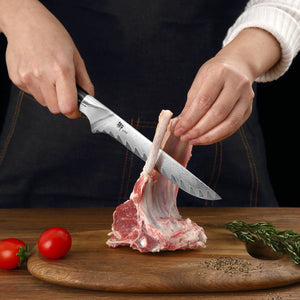
To get the most out of the best boning knife, it is essential to understand its purpose. Used in the kitchen, a boning knife has a sharp edge and a narrow, thin blade. More often than not, a boning knife, as the name suggests, is used during food preparation to remove bones and ligaments from fish, poultry, and meat.
The length of a boning knife varies from one type to another, but it is usually around 12 cm to 17 cm long. The narrow blade of the best boning knife is what sets it apart from the rest in the kitchen. Its thin, narrow blade makes it perfect for the precision required when deboning. A sharp, precise blade can make deeper holes and cuts. Moreover, the flexibility of a boning knife is helpful when working with fish and poultry.
Types of Boning Knives
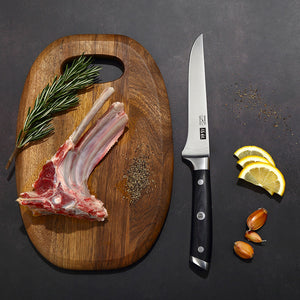
There is a wide range of boning knife types available. Choose the one that best suits your needs. It is also advisable to keep more than one type of boning knife on hand for professional deboning.
The following are some of the most common types of boning knives.
1. Wide Boning Knives
Wide boning knives, as the name suggests, have wider blades and are preferred for cutting pork and chicken. The blade is stiffer, making it easier to cut through the texture of both.
2. Narrow Boning Knives
Narrow boning knives have the narrowest blades and are especially useful when working with ribs. The narrow blade of the best boning knife of this type can easily slice and cut through cartilage and bone, providing a high level of precision and ease. Usually made of steel, these knives often feature finely honed edges.
3. Stiff Boning Knives
Stiff boning knives are perfect for sturdy cuts of meat, including beef and pork. If you plan to prepare raw meat that is especially thick and tough, you may want to use a stiffer boning knife. T-bone chops and beef, for example, are too resistant for a flexible blade, so a stiffer one is used for fast, clean cuts.
4. Flexible Boning Knives
Flexible boning knives can bend, allowing you to reach areas of meat that would otherwise be impossible to access. Bones with curves or rounded ends can sometimes be particularly challenging to work around. These unusual shapes may hold onto valuable slices of meat packed with flavor. This is where a flexible boning knife comes in handy.
Fillets and narrower cuts of meat that are more difficult to bone can be readily penetrated using a flexible boning knife. These are quite similar to fillet knives.
5. Curved Boning Knives
As you search for the best boning knife, you will come across various curved boning knives. As the name suggests, these have a curved edge that makes it easier to angle the knife while chopping and cutting around the bone. Curved boning knives are relatively smaller than flexible ones and are best for deboning and removing skin from fish and poultry. They are also best used when working with tender meats and delicate poultry.
Boning Knife Uses
Boning knives offer a wide range of uses, from cutting away cartilage to removing skin from different types of meat and eliminating minute ligaments such as silverside. Using the best boning knife in the kitchen is essential because it provides a level of precision that a regular knife, no matter how sharp it is, cannot match. Below is a complete look at the different uses of the best boning knife.
· Removing Skin
The best boning knife can help with the intricate task of removing skin from meat, including silverside. Since these knives have narrow, flexible blades, they can remove skin from poultry and even remove sinew from red meat.
· Removing Bones
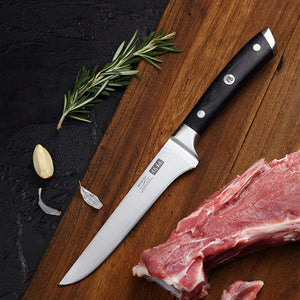
The most common use of a boning knife is to remove bones from chicken, meat, or fish. The best way to remove a bone is to locate it and make a small incision. Once made, the incision can help remove a wider piece of meat, providing clear access to the bone.
How to Choose the Best Boning Knife?
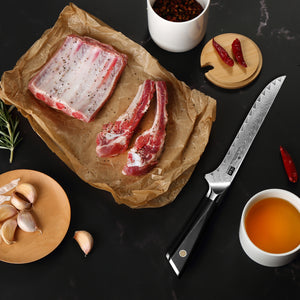
To get the best boning knife, you need to consider a few aspects before making your purchase. Here is what to look for in the best boning knife.
· Blade
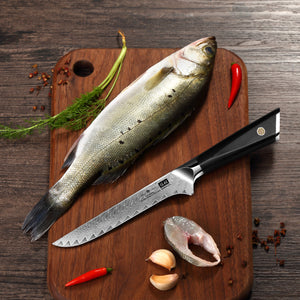
The blade is the most important part of the knife. There are two options available: you can choose either a stiff blade or a flexible one. The answer depends on how you plan to use the knife. A stiff blade is usually preferred because it cleanly removes the bone from the meat.
There is also the option of a semi-flexible blade, which would work great if you are looking for a knife that can serve as both a fillet knife and a boning knife. The blade design is another factor, and you can choose from narrow, wide, stiff, flexible, and curved blades.
· Size and Shape
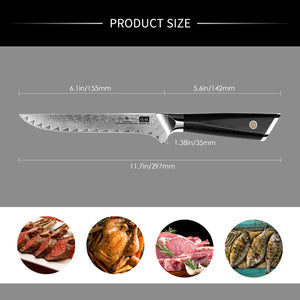
Next is the knife's shape and size. This is a crucial factor because it affects handling and comfort. Fortunately, boning knives come in a variety of shapes and sizes, allowing them to accommodate different cutting needs.
A six-inch blade is perfect for basic cutting, with a steep profile and pointed tip. The size mainly depends on the amount and size of the meat you are working with. For everyday use, a six-inch knife works well, but you can choose a larger size for bigger cuts.
· Finger Guard
Safety is of utmost importance when handling knives, whether you are a beginner or a professional. Fortunately, boning knives come with a finger guard located between the blade and handle. It provides a firmer grip, which is often needed when cutting through slippery or wet meat. The finger guard is positioned so that professionals can disregard it if necessary, while beginners can benefit from it.
· Construction
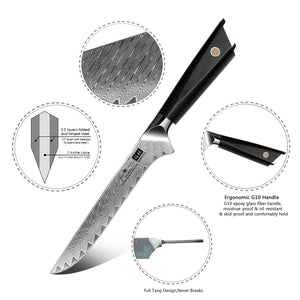
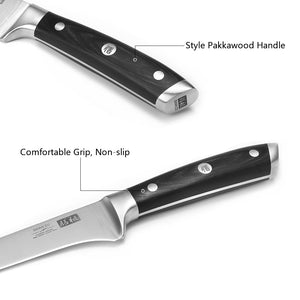
The knife's construction is another factor to consider. Look at the material, tang, and handle. Boning knives with wooden handles are considered the epitome of elegance, but they tend to warp after prolonged exposure to water.
Metal handles are durable, but they may provide a less secure grip. Polypropylene is the recommended material because it requires minimal maintenance and can last a long time.
FAQs
1. What's the difference between a boning knife and a fillet knife?
The main difference between a boning knife and a fillet knife is their weight and construction. The best boning knives are relatively heavier and more rigid. Fillet knives, on the other hand, are lighter and more flexible.
2. Which type of boning knife is suitable for removing bones in confined spaces?
A curved boning knife is the most suitable type for cutting through skin and deboning fish and poultry in confined spaces.
3. Do you need a boning knife?
Yes, a boning knife is essential for anyone who works with poultry. Rather than relying on specialized knives for cutting through meat and bones, slicing bread, or other small precision tasks, boning knives are the preferred choice.
4. Are boning knives flexible?
Yes, boning knives have flexible, thin blades designed to debone meat and cut straight through tissue and ligaments.
5. How can I sharpen a boning knife?
Since the blade is thinner, it is recommended to angle the knife on a whetstone and sharpen one side at a time by applying light pressure. Once finished, rinse your knife, and you're done.
6. How do you clean a boning knife properly?
Always clean your boning knife quickly after each use with warm, soapy water and a clean cloth or gently brush it if necessary to remove dirt, then dry it with a towel.




Comments (0)
There are no comments for this article. Be the first to leave a comment!