

What Is a Santoku Knife?
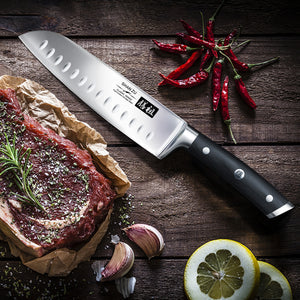
If you are not a professional, a Santoku knife looks exactly like a chef's knife. Most people often mistake Santoku knives for chef's knives. The reason is simple: not only do they look similar, but they also serve the same purpose. It is essentially a multipurpose knife used regularly in the kitchen for all kinds of chopping and slicing tasks.
Created in Japan during the 1940s, Santoku bocho can be translated as "Three Virtues." The knife is named this because of its versatility. It can be used for cutting, slicing, and even chopping. This origin sets it apart from a chef's knife. Another distinguishing feature between the two is the shape of the blade. Typical Santoku knives are 5 to 8 inches long, while a chef's knife is longer and usually ranges from 8 to 12 inches in length. As for the blade, Santoku knives have a much wider blade with a sheep's-foot tip. Despite its width, the blade itself is thinner, allowing for greater precision.
Simply put, a Santoku is a kitchen knife with no specific use, as it can be used for cutting and slicing anything from raw meat to fruits and vegetables. It is made in Japan and is shorter than a chef's knife, with a wider blade that lacks curvature.
What to Look for When Buying a Santoku Knife?
If you are looking for high-quality Santoku knives, there are a few things to look for. Here are the features you need in a well-made Santoku knife:
Ergonomics & Handle:
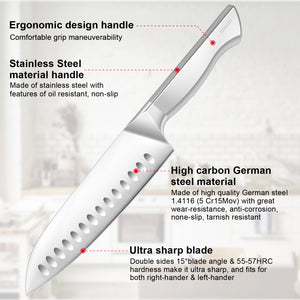
Santoku knives are designed specifically for precise cutting with minimal effort and error. This is why, even though the blade is wider in proportion to that of a chef's knife, the knife is lighter to hold. The knife has a balanced weight because it has no bolster. A Santoku knife is ergonomically superior to most knives because it is lighter, reducing strain during use and making the knife more agile.
Santoku knives come with handles in a variety of materials, from wood to metal and everything in between. When choosing the best option, it is always recommended to hold and feel the knife: how well it fits in your hand and how easy it is to use. Everyone has their own preference regarding the handle's weight and shape, which is why testing the knife before buying it is a good idea. In most cases, you can determine almost instantly which knife feels most comfortable in your hand. The handle material also depends on your preference. Santoku knives are among the best knives available, so there is no doubt about their sturdiness. Different handle materials have their pros and cons: wood is natural and provides a strong grip but can be difficult to clean. Metal, on the other hand, may become slippery when wet, but it is easy to clean and durable.
Blade Material:
Santoku knives also come in a variety of blade materials. You can find a Santoku knife made of ceramic, but it lacks flexibility and is less durable than steel. The best Santoku knives have a high-carbon steel blade. Chef's knives usually have a stainless-steel blade, which is sturdy but less so than steel with a high carbon content. A high-carbon steel blade is forged using a technique that involves hammering a piece of steel to form the blade, and this technique produces a much more durable and sturdy blade than a stainless-steel one. So, if you are looking for longevity and durability, a high-carbon steel blade is the most desirable option.
Blade Design:
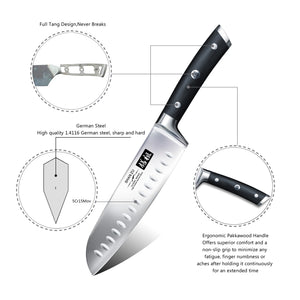
Santoku knives have a unique blade design, which usually sets them apart from chef's knives. The blade of a Santoku knife is wider and thinner. It is also, in most cases, single-beveled, though you can find Santoku knives with double bevels as well. The blade has a straight edge with a curved tip instead of the sharp point found on most chef's knives. Santoku knives may have a plain edge or a Granton edge, which has indentations. Look for these key characteristics in the blade design when buying your Santoku knife to be sure that you are buying an authentic one and not an imitation.
One key thing to note when buying a Santoku knife is to check the sharpness of the blade. You must make sure that the knife's blade is sharp from the outset. If you get one that is already sharpened, you will not need to sharpen the blade, which will improve the knife's longevity.
What is the difference between a chef's knife and a Santoku knife?
It is easy to confuse a chef's knife with a Santoku knife. The two are similar in appearance and function, making it hard to tell them apart. If you know what to look for, however, distinguishing Santoku knives from chef's knives is not difficult.
Santoku knives are made in Japan, while most chef's knives originate from either Germany or France. In terms of appearance, Santoku knives are shorter and have a wider blade that is thinner than the blade on a chef's knife. The blade is specially fashioned in the shape of a sheep's foot, and the tip does not have a sharp point.
Chef's knives have a double bevel, so either side can be used for cutting. In contrast, Santoku knives usually have a single bevel, so they are sharp on only one side. Another distinguishing feature is the way the handle is connected to the blade. Santoku knives do not have a piece of metal known as a bolster connecting the blade to the handle, as chef's knives do.
Main Features of a Santoku Knife
To summarize the basic features of Santoku knives, it is important to note that these knives originate from Japan. They are multifunctional, a characteristic that is clear from the name of the knife, since Santoku means "three virtues." The knife can be used for cutting, dicing, slicing, and mincing fruits, vegetables, meat, or poultry.
Length
The knife is around 5 to 8 inches long, which is a reasonable length—long enough for a decent grip yet short enough to allow for accurate handling.
Weight
Santoku knives are lightweight and easy to hold and use. This feature also makes it comfortable to use the knife for long periods without straining the hand or applying unnecessary pressure.
Blade
The blade is also shorter and wider for greater control, while the blade is thinner for more precise cutting. Furthermore, the shape of a Santoku knife's blade is unique, with a sheep's-foot shape, a straight edge, and a curved tip. The tip does not have a sharp point, so there is no possibility of accidentally puncturing the food being prepared. This makes it easy to use, even for amateur chefs and home cooks.
Other features include a single- or double-beveled edge, which may be smooth or Granton. The blade and handle do not have a bolster in between, which is a design feature that adds to the sturdiness and ergonomics of the knife.
Material
The material of the blade is a high-carbon steel that I extremely strong and can withstand much more pressure without bending, rusting, or becoming blunt.
If you own a Santoku knife, then you know just how useful it is as a vital kitchen tool. It performs multiple tasks and is just the right size that anyone can handle. You do not need to be a trained professional to maneuver a Santoku knife.
How We Test It?
Testing out any blade is highly recommended. Not every knife suits everyone; this may be due to its design features or utility, or both. Since Santoku knives are supposed to be used on a variety of food items, it is best to test them on different surfaces. Here are the various tests we conducted using Santoku knives on a range of different materials to gauge their prowess and performance. The results were as follows:
Test 1: Paper
Paper is a challenging material to work with. It is thin and flimsy, offers little resistance when holding its shape, and is therefore difficult to cut accurately. A Santoku knife’s blade is so sharp and thin that it can slice through a single sheet of paper without any problems. The cut is clean and smooth. There are no uneven edges, as the blade runs through paper like butter. This is truly unprecedented, since paper is not a typical material for kitchen knives, which are not designed to cut through it. Santoku knives’ ability to slice paper with such precision is a testament to their ingenious design.
Test 2: Vegetables
Santoku knives are the best tools for cutting, dicing, chopping, or slicing vegetables. The knife works just as well on large, hard-to-cut vegetables like pumpkins and cabbage as it does on smaller ones like cucumbers, carrots, and peppers. Since the blade is thin, it is possible to get exceptionally thin slices of any vegetable. Whether you want to cut vegetables into thick, chunky pieces or delicate, thin ones, a Santoku knife can achieve the desired results.

Test 3: Meat
Like mutton, pork, and beef, meat presents a challenge when cutting. This is because meat, whether raw or cooked, is much tougher than poultry or vegetables. Meat also contains fat that can be difficult to separate or cut through because of its gelatinous consistency.
Santoku knives work perfectly for cutting meat. The blade is sharp and thin, allowing for clean cuts.

Test 4: Fish
Handling and cutting seafood is an art—one that the Santoku knife handles expertly. Santoku knives come from Japan, a nation that loves its seafood. It is no surprise, then, that this knife works well for cutting and preparing fish. Even when the fish is wet and slippery, the handle’s design provides a secure grip that prevents your hand from slipping. You can get clean cuts through any type of fish using a Santoku knife.
Frequently Asked Questions About Santoku Knives
1. Should I buy a Santoku or a chef’s knife?
You can buy either; it depends on your preference. Both are similar in functionality. The Santoku knife has the advantage of being lighter and easier to use. So, if you are a beginner or amateur cook, the Santoku knife is most likely a better option for you.

2. What should I use a Santoku knife for?
Anything. The Santoku knife is a versatile kitchen tool. It is great for cutting and slicing vegetables, poultry, meat, and fruit. It is good for general-purpose food preparation. For specific tasks such as deboning or carving meat, you will need a specialty knife.

3. What are the dimples on a Santoku knife?
The dimples found on some Santoku knives are properly known as a Granton edge. This patented design feature serves an important purpose: the knife's scalloped or indented edges prevent the blade from sticking to the food being cut. Moist foods, such as wet fish or meat, can be very sticky, which may interfere with the cutting process. These dimples make it easy to cut food quickly and efficiently.

4. Are Santoku and chef's knife blades the same size?
The blade sizes of Santoku knives and chef's knives vary slightly. Typically, a Santoku knife blade is anywhere from 5 inches to 8 inches long. On the other hand, a chef's knife blade is 8 inches to 12 inches long.
5. How do I clean my Santoku knife?
Cleaning your knife after use is critical, especially if it has a high-carbon steel blade. Wash the knife with regular dishwashing detergent and wipe it dry. Do not wait for it to air-dry. Remember to always keep the blade away from acids. Clean it immediately after it comes into contact with foods with a high acid content, and use an alkaline-based soap to restore the pH balance. Acid is not good for high-carbon stainless steel blades, so extra care must be taken.
6. How do you sharpen a Santoku knife?
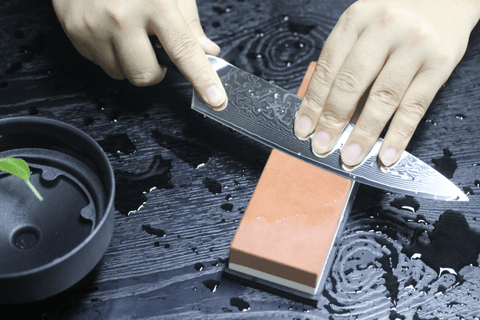
The best way to sharpen Santoku knives is the old-fashioned way: using a whetstone. Begin by soaking the whetstone in water. First, sharpen the coarse edge, if it is a double-bevel knife, by running the blade up and down the whetstone at an angle. Be sure to sharpen the entire edge of the blade.
7. Besides a Santoku knife, what other knives do I need?
It depends on your usage and skill level. If you are preparing food for yourself and your family, a simple yet versatile knife like a Santoku knife is good enough. It is also useful to have a paring knife on hand for more delicate tasks. If you regularly need specialized knives, such as a carving knife, buy one since you will use it often.


Comments (0)
There are no comments for this article. Be the first to leave a comment!