

Knives are important tools for a variety of kitchen tasks. Each task requires a specific type of knife, such as removing the bones and skin from meat. This type of knife is known as a boning knife.
What Is a Boning Knife?
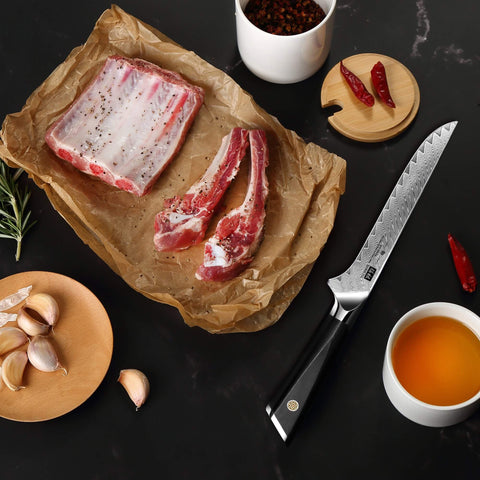
A boning knife has a thin, flexible, and, most importantly, sharp blade to help separate meat from the bones. Its curved blade is designed to let you remove meat from joints and bones with ease, with little to no waste. Moreover, it enables you to cut precise, thin slices.
The Blade of a Boning Knife
You will often find that the most delicious part of the meat is closest to the bones. Therefore, you need a good-quality boning knife with a suitable blade to ensure that you can remove this flavorful part.
A suitable boning knife for both home and professional use is the classic type. It has a flexible, soft blade that can easily follow the outline of the bone. However, if you need a boning knife for a particular type of meat, there are several blades to choose from.
· Flexible Blade
This type of blade can flex to handle the most intricate tasks. It allows you to cut around complex shapes and tighter corners.
· Stiff Blade
Thicker, tougher meat requires a more robust blade to ensure that you stay on course while separating the meat. Stiff blades are therefore used to make wide cuts.
· Curved Blade
The curve of a boning knife facilitates removing bones in a single swipe and helps create clean, long strokes through the flesh. Its shape also makes delicate tasks easier to perform effectively and allows for easy maneuvering in small spaces.
· Straight Blade
A straight blade helps remove large chunks of meat, such as beef. It is ideal for precise sculpting and slicing, as well as fast removal.
· Narrow Blade
Sometimes, narrow blades are needed to cut around smaller edges and angles. They move through the skin with little to no resistance, ensuring that the meat is not damaged.
· Broad Blade
Broad blades make sturdy, wide knives, which are important for cutting thick sections of meat.
· Finger Guard
This is the part of the knife located at the rear of the blade. As its name suggests, the primary function of a finger guard is to protect your fingers when holding the handle. Therefore, the larger the finger guard, the lower the risk of cutting yourself with the knife.
The Pros and Cons of a Boning Knife
Overall, a boning knife is a good investment and can be used to accomplish several tasks.
- A boning knife has a rigid blade, which helps it maintain its sharpness for a relatively long time.
- It helps you make smooth cuts, even when handling a complex beef joint.
- That is why you can enjoy the best meat.
- It makes sure that the meat removed is presentable and preserved.
On the other hand, there are a couple of downsides to a boning knife.
- If you use a flexible boning knife to cut a thicker piece of meat, you could end up damaging your knife or injuring yourself.
- Using a larger boning knife for intricate jobs puts you at risk of losing control.
The Differences Between a Fillet Knife and a Boning Knife
While both knives are used to separate skin and bones from meat and fish, they have considerable differences.
· Difference in Purpose
While a boning knife can be used to separate the skin and bones from poultry, meat, and fish, a fillet knife is better suited to working with the tender meat of fish. Consequently, it is smaller and more flexible.
· The Difference in Blade Length and Weight
Each knife is available in different lengths. Usually, you will find both in the 5-to-8-inch range. Although they are a similar size, fillet knives are often lighter, as intended by their construction and design. Their blades also tend to be thinner.
· The Difference in Blade Maneuverability
Since fillet knives are designed to provide greater flexibility, you can make precise cuts with them. On the other hand, boning knives are known for their rigidity and are mostly used to cut through the connective tissue that separates the meat from the bones.
· The Difference in Blade Design
Boning knives are designed to be straight to the tip of the blade. This allows you to pierce the meat easily. Fillet knives, however, have an upward curve and therefore a curved tip. They are designed to make it easier for you to make steady, long cuts.
Do You Need a Boning Knife?
Buying a boning knife is a worthwhile investment, especially in the long run, if you usually work with considerably larger pieces of meat. It is important for butchering meat and effective, since using an ordinary chef's knife can only produce subpar results at best.
When and Why Should You Get One?
Here are several instances when you will want to get yourself a sturdy, high-quality boning knife.
- Planning on frequently filleting fish or deboning meat and poultry.
- You want to get the most flavorful meat available.
- You want to make straighter and smoother cuts, making your dishes look more presentable.
- You want to trim larger pieces of meat into smaller ones.
- When the rest of your ordinary knives start to become damaged or dull because they are not designed to help remove bones from meat.
When Do I Not Need One?
There are also times when buying a boning knife will prove futile. This usually happens in the following cases.
- You want to cut through tougher types of cartilage and bones when processing animal carcasses.
- You have various other knives that can easily get the job done.
- You do not cut meat regularly.
How to Choose a Great Boning Knife
If you already have different knives in your kitchen for various tasks, kudos to you! However, there is no better knife for cutting meat than a boning knife. When choosing one for yourself, here are the things you need to consider.
· Blade Design
Some blades are curved, while others are straight. This design makes all the difference and determines whether you spend 5 minutes or twenty removing the bone. A curved blade allows you to remove bones in a single pass, whereas a straight blade is better for separating more intricate pieces of meat.
· Knife Handles
The handle of a knife is where you apply all your pressure. You can choose from a variety of handles, ranging from hard plastic to wood, based on appearance and preference. If you choose synthetic materials such as polypropylene, you will get a handle with multiple coatings to improve your grip.
· Blade Material
Stainless steel is primarily used to make blades. When you go to buy a knife, you will see different forms of this steel, ranging from high-carbon to cold steel to tempered steel. All of these materials will help you get the job done.
High-carbon blades are lightweight, while durability is the most important feature of cold-steel blades. However, any blade type you choose can provide sufficient sharpness and durability for successful deboning.
· Blade Size
On average, the blade of a boning knife is between 5 and 6.5 inches long. The smaller the blade, the greater the flexibility you can expect. Although no single size can handle every type of cut, you will need a small blade to remove bones from delicate areas.
On the other hand, a larger blade is used to make bigger and broader cuts.
The Use and Purpose of a Boning Knife
How to Hold a Boning Knife
The ergonomic shape of a boning knife may take some getting used to. Its curved stainless-steel blade and flexible design make it stand out from all other kitchen knives. However, you can easily learn how to use a boning knife, just as you can learn to use the rest of your kitchen tools.
The first thing you need to do is hold the knife with your dominant hand. Next, wrap your thumb, middle finger, and ring finger around the handle. These three fingers provide a good grip throughout the deboning process. Once this is done, place your index finger on top of the blade and ensure that it is firmly in place. Doing so will help stabilize your movements as you navigate around the bones and skin.
Use your other hand to steady the meat throughout the cutting process on the surface you are using. Make sure your fingers are curled at all times to prevent accidents or injury.
Uses of a Boning Knife
Here are a handful of uses for a boning knife and how it makes your work easier in the kitchen.
1. Removing Bones
During the bone-removal process, you will first want to ensure that you have a cutting board with enough workspace to complete the task.
Take the piece of meat and place it flat in the center of the board. Next, locate where the meat ends and the bone begins, and outline the selected bone with the tip of your boning knife. Using a swift sawing motion, use the rest of the blade to detach the meat effectively and easily.
2. Removing Skin from the Meat
As mentioned above, the shape and flexibility of the boning knife's blade help with maneuvering through difficult areas of the meat. The slender tip is especially useful for breaking away cartilage in the joints. Moreover, you can easily remove the breast from the carcass and separate the thigh and drumstick from the backbone without leaving any splinters.
All you need to do is make a small cut between the flesh and the skin with the tip of the boning knife. Then, make sure to have a firm grip on the separated skin and make multiple slicing motions to finish the job.
3. Removing Skin from a Fish Fillet
A fillet knife is built for a more specific purpose; however, a boning knife is designed to help separate the skin from a fish fillet and debone meat.
The first thing you need to do is place the fish horizontally on the surface you are using for cutting with the skin facing downwards. It is recommended that the thinnest piece of the tail is closest to you. Carefully make a small cut, no bigger than two inches, from the bottom. Once this is done, smoothly slide the blade between the flesh and the skin and away from you until you arrive at the other end.
The slower and steadier you are when carrying out this process, the more likely you are to slice off the skin without leaving any traces of meat on it.
4. Slicing Baked Goods
If you enjoy baking and want to carve creative shapes and designs, you will want to invest in a boning knife. Not many people are aware of this, but the thin blade, an important feature of a boning knife, is perfect for accurately carving the rounded and straight lines needed to even out cakes. You can also use it to even out the layers and shape them however you want.
5. Carving Fruits and Vegetables
A boning knife can come in handy when preparing trays of fresh fruits and vegetables or decorative arrangements. The small blade facilitates this process, especially when working with small produce.
Other Uses of a Boning Knife
In addition to using a boning knife to prepare fruit trays, you can also peel the rinds or skins of fruits and vegetables, much like peeling skin from meat. The size and shape of the blade make it easier to peel mangoes and papayas and remove pineapple skin.
On the other hand, a boning knife can also be used to cut cookie dough. You can carve out any shape for any occasion, as long as the dough is cold enough to prevent sticking or tearing.
How to Care for a Boning Knife
A boning knife is like any other knife in your kitchen and should be treated accordingly. Do not put it in the dishwasher; clean it regularly. It should also be stored with the rest of your knives.
· How to Clean a Boning Knife
After every use, a boning knife should be washed with warm, soapy water. Use a gentle brush or soft cloth to remove debris, then wipe it dry with a towel. Before putting it away, make sure it is completely dry and ready for use.
· How to Sharpen a Boning Knife
Eventually, all knives become dull and blunt with regular use. A boning knife is no different and can be sharpened using several options, ranging from home sharpeners to qualified professional services.
You can use a whetstone at home by holding your knife at the correct angle. Ensure that the stone is moist and use light pressure to move the blade back and forth across it. Repeat this process a couple of times on each side until a sharper, newer edge is revealed. Alternatively, you can use electric home sharpeners with preset angles and no customization options.
Top SHAN ZU Boning Knives
Boning knives from SHANZU are known for their innovative and beautiful designs and provide greater value than traditional brands. They all boast exceptional precision, superior performance, and razor-sharp blades.
Furthermore, premium materials are used to ensure the effectiveness and superior craftsmanship of every knife, including boning knives.
· SHANZU Classic Series 6-Inch Boning Knife

The 6-inch boning knife is ideal for quickly and efficiently removing skin and bones from meat. Its thin, sleek blade allows for clean separation while preserving the flavorful parts of the meat. In addition, the blade is exceptionally sharp, producing precisely cut pieces of meat.
Since a finger guard is of utmost importance in a boning knife, the handle has been ergonomically designed for a beautiful, comfortable feel. It is secured to ensure superior quality and balance.
· SHANZU GYO Series 6-Inch Boning Knife
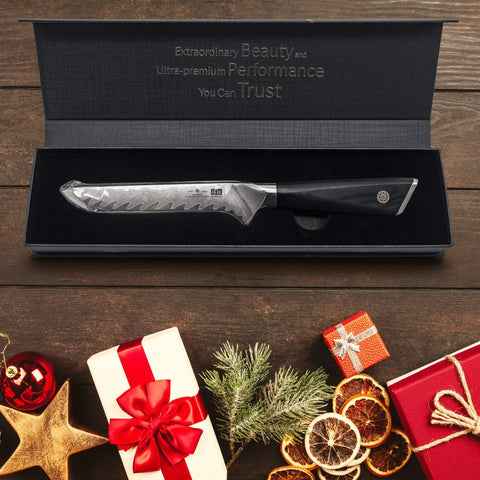
The GYO series is known for its exceptional precision and sharpness. The boning knife in this series also enables effortless, efficient cutting and long-lasting edge retention. Its tip minimizes resistance against the surface, cutting meat smoothly into slender pieces.
One of this knife's most attractive features is its easy maintenance. The stainless steel used to manufacture the blade provides impressive rust and corrosion resistance.
Common Q&A About Boning Knives
· Should I buy a fillet knife or a boning knife?
If you are looking for a knife to cut around bones, you need a boning knife designed specifically for this purpose. It facilitates the removal of skin and bones from meat, poultry, and fish. However, if you only want to separate a fillet from a fish, choose a fillet knife, which performs this function more effectively.
· How do I sharpen a fillet knife and a boning knife?
For both knives, you have multiple options. You can either sharpen them at home using a whetstone or an electric sharpener, or seek out a professional to do the job for a fee.
· How long are fillet knives and boning knives supposed to be?
Usually, these two types of knives range from 5 to 8 inches. However, you may also find them in larger sizes. Since fillet knives are specifically designed for filleting fish, they are commonly found on the smaller side.
· What kind of knife do you use to cut fish?
Fillet knives are designed to make cutting fish and removing its bones easy and efficient. Numerous fish knives feature cutting edges, but the most common types are fillet knives, tuna knives, and large serrated knives.
With this complete guide covering everything about boning knives, there is nothing you cannot tackle.


Comments (0)
There are no comments for this article. Be the first to leave a comment!